
UNFUCG
DashboardSearchChatBookmarksNotificationsActivityPremiumProfile
?
Home
Search
Chat
Saved
Profile
Episode
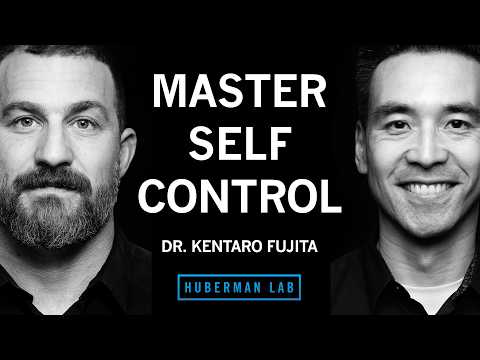
Master Self Control & Overcome Procrastination | Dr. Kentaro Fujita
~197 min
Episode Brief·YouTube

Master Self Control & Overcome Procrastination | Dr. Kentaro Fujita

Andrew Huberman
Watch on YouTube Add to chat My bookmarks← All sources

TL;DR

The four things you'd lose by not watching

4 items

TL;DR

The four things you'd lose by not watching

4 items
1

Self-control is not an innate trait but a learnable skill, as demonstrated by the marshmallow test experiments where children taught specific strategies (like covering the marshmallow) improved their delay of gratification.

2

The 'why' behind a goal is a powerful motivator; thinking about higher-order purposes (e.g., family, being a good example) significantly increases the ability to overcome temptation compared to just focusing on the 'how' or the immediate denial.

3

There is a critical distinction between willpower (effortful inhibition, which is hard to train) and self-control strategies (psychological distancing, reframing, leveraging intrinsic motivation), with the latter being far more effective and teachable.

4

The concept of a 'self-control toolbox' is key: different strategies (abstinence vs. moderation, fighting fire with fire, mental time travel) work for different people and contexts, and failure should be seen as an opportunity to discover which tool works best for you.

Protocols

Concrete recipes — what, when, how much, and why

5 items

Activate Your 'Whys' to Overcome Temptation

WhatWhen facing a self-control conflict, deliberately think about the higher-order, abstract purposes ('whys') behind your goal instead of the concrete, immediate difficulties ('hows').
WhenIn the moment of temptation or when feeling unmotivated to start a hard task.
DoseA brief moment of reflection.
For whomAnyone struggling with procrastination or temptation.
WhyShifting to an abstract 'why' mindset simulates psychological distance, making the long-term goal more salient and powerful than the immediate temptation.

Dr. Fujita's research demonstrates that priming people to think about 'why' they pursue their goals improves their performance on subsequent, unrelated self-control tasks. This is because it simulates the mindset of a distant goal, where the purpose is clear and motivating. In contrast, when a task is imminent, our minds naturally shift to the 'how,' which for difficult tasks is unpleasant. This explains why we can be motivated for a future goal but fail to act in the present. The protocol is to consciously re-engage the 'why' mindset when you need to act, effectively fighting the concrete, negative 'how' with the abstract, positive 'why.'

Mechanism

Psychological distance changes our mental representation of an event. Distant events are construed abstractly (the 'why' - desirability), while proximal events are construed concretely (the 'how' - feasibility). For hard tasks, the 'how' is inherently negative, creating resistance. Activating the 'why' overrides this by engaging higher-order motivations and meaning.

If instead I'm saying things like I need to do this for my family... these higher order reasons that you might have for getting healthier... we show that that increases the odds that people will avoid the cake.

Also said
“In my lab, we've conducted experiments in which we have people think about... why they're pursuing their goals or how they're going to pursue those goals... and they have much better self-control when they've thought about whys than hows.”— Provides the direct experimental evidence for the protocol.

Use Psychological Distancing Techniques

WhatCreate psychological distance from a temptation by using third-person self-talk (e.g., 'What would Ken do?') or by adopting the perspective of a role model (e.g., 'What would Batman do?').
WhenWhen facing a self-control conflict.
DoseAs needed.
For whomAnyone, particularly those who respond to cognitive reframing.
WhyCreating psychological distance, even through simple linguistic shifts, makes the situation feel less immediate and emotionally 'hot,' allowing for more goal-directed decision-making.
CaveatsMay be more effective for verbal thinkers than visual thinkers.

Dr. Fujita discusses research by his colleague Ethan Kross showing that using one's own name instead of 'I' during self-talk creates distance and improves self-control. Similarly, a study by Angela Duckworth had children pretend to be a hardworking character like Batman while doing a boring task, which significantly improved their persistence. This works because simulating another person's mind activates the neural circuitry associated with that mindset, effectively 'turning you into somebody else' who is better at the task. This is a powerful tool because it doesn't require suppressing the desire, but rather reframes the entire situation from a more empowered perspective.

Mechanism

Referring to oneself in the third person or adopting another's perspective creates a sense of psychological distance. This shifts the mental representation of the conflict from an immersive, 'hot,' first-person experience to a more detached, 'cooler,' third-person observation. This detachment reduces the power of the immediate temptation and allows for more abstract, goal-consistent processing.

Referring to yourself in the third person as opposed to me... just simply referring to myself as other people... would create psychological distance in the space that allows that gives me just enough to think of it as far as opposed to close.

Also said
“They gave the children various costumes... And then they were simply asked, 'As you do this task, we want you to ask the question, what would that character do?'... they showed that thinking like Batman made them have better self-control.”— Provides a concrete, evidence-based example of the protocol in action.

Fight Fire with Fire: Use 'Hot' Counter-Motivations

WhatInstead of trying to 'cool down' a temptation, actively imagine a short-term negative consequence of indulging (e.g., the sugar crash, a cockroach on the cake) or a powerful positive aspiration (e.g., being a good role model).
WhenIn the moment of temptation.
DoseA brief, vivid mental image or thought.
For whomPeople who find that 'cool' cognitive strategies don't work for them.
WhyThis leverages the power of the limbic system to fight a limbic-driven temptation, rather than relying on effortful, cognitive suppression which can fail.
CaveatsThe specific counter-motivation must be personally potent.

Dr. Fujita highlights this as a new and exciting direction in self-control research, challenging the dominant 'cool cognition' model. He cites his own work on 'whys' (positive 'hot' motivation) and the work of Paul Stillman and Caitlin Woolley on short-term losses (negative 'hot' motivation). The key is that the counter-motivation must be immediate and visceral to compete with the immediate temptation. This is not about long-term health consequences, but about the immediate disgust of a cockroach or the immediate pride of being a good example.

Mechanism

The traditional model assumes 'hot' emotional systems drive impulsive behavior, so the solution is to 'cool' cognition. This protocol proposes the opposite: use a 'hot' system to fight a 'hot' system. By vividly imagining a disgusting or fear-inducing short-term outcome of indulgence, you activate an avoidance motivation that directly counteracts the approach motivation of the temptation. Similarly, imagining a deeply meaningful positive outcome activates a powerful approach motivation that can overpower the temptation.

We might be able to use the limbic system. We might be able to use our hot reactions... they might be what inspires us and gives us the motivation to do the right thing.

Also said
“They had people think about the short-term losses of indulging. So, what are some of the things like what's the like think about the sugar crash that you would experience if you ate the chocolate cake... they showed that that kind of served much like you were talking about the vomit response, it pushes people away far enough.”— Provides the research backing for the negative 'hot' counter-motivation strategy.

Build a Self-Control Toolbox Through Exploration

WhatInstead of relying on willpower alone, actively experiment with and catalog different self-control strategies (distancing, reframing, 'whys,' etc.) to find what works best for you in specific situations.
WhenAs a lifelong practice for goal pursuit.
DoseOngoing.
For whomEveryone.
WhyDifferent strategies work for different people and in different contexts. A toolbox approach reframes failure as information gathering, promoting resilience and growth.
CaveatsRequires self-awareness and a willingness to experiment and fail.

Dr. Fujita and his colleague Ethan Kross wrote a paper on the 'self-control toolbox.' The core idea is that there is no one-size-fits-all solution. A strategy like 'fighting fire with fire' might work for someone who is reactant, while it could be demotivating for someone else. The process is one of trial and error. When a strategy fails, it's not a personal failure but a signal that the wrong tool was used. This learning approach is more hopeful and sustainable than believing one has a fixed amount of 'willpower.' The goal is to discover your own constellation of tools through exposure and reflection.

Mechanism

This is a meta-strategy. It's based on the principle that self-control is not a single skill but a collection of cognitive and behavioral tools. The mechanism of action for each tool varies (e.g., psychological distancing, cognitive reframing, motivational enhancement). The key is to match the right tool to the person and the context.

Personal experience

Dr. Fujita shares a personal example: 'For me, getting started with the workout is the hardest part... The strategies I use for that, I usually tell myself, like, you know, what would my heroes do in this situation?... But when it comes to the end, when I'm like just pumping out that last rep... willpower might be a better strategy.'

We have lots of different ways to enhance self-control. We speculate that certain tools might work better for certain people at certain times... The self-control toolbox approach explicitly embraces the idea that different things are going to work for different people.

Also said
“I think we have to explore the entirety of the self-control toolbox. We have to be And through trial and error, find what works best for us.”— Emphasizes the active, exploratory nature of the protocol.

Leverage Social Validation for Motivation

WhatShare your goals with a trusted person who will validate them in a way that creates a 'shared reality,' making the goal feel more real and powerful.
WhenWhen setting a new goal or needing a motivational boost.
DoseAs needed.
For whomPeople who are socially motivated.
WhyHumans are a social species. When someone we respect validates our goal and expresses belief in us, it creates a powerful sense of shared reality that solidifies our commitment.
CaveatsThe effect is dependent on the quality of the interaction. A dismissive or perfunctory response can be damaging. The validation must feel genuine and create a sense of being on the 'same wavelength.'

Dr. Fujita contrasts a generic 'You belong' banner with a personal, validating conversation. The latter creates a shared reality that has a much bigger impact. He speculates that telling someone 'I'm going to do this' and having them respond with 'I know you're going to do this' is far more powerful than a non-committal response. This is because the social validation makes the belief more real and thus has more power. This protocol suggests that the social context of goal-setting is not just a nice-to-have but a fundamental part of the motivational process.

Mechanism

The concept of 'shared reality' suggests that when we communicate a thought and receive validating feedback that makes us feel understood, the thought becomes 'real' in a more powerful way. This social validation process is distinct from simply saying a thought aloud or writing it down. It leverages our fundamental need for belonging and connection, turning a private intention into a socially verified commitment.

If someone says, 'Hey, you know what? I think you really belong. I think um I'm really happy that you're here.'... If it's conveyed in a way that makes you feel like they understand you and that you guys are on the same wavelength, that actually has a very powerful effect.

Also said
“There is research suggests that um that when you communicate something to somebody and then they respond in a way that makes it seem like you are on the same wavelength, that that creates an experience known as shared reality. People put a special premium in truth value to those interchanges.”— Explains the psychological mechanism behind the protocol.

What's new

Personal practice updates, fresh positions, predictions

4 items

Fighting Temptation with 'Hot' Counter-Motivations

Instead of cooling cognition to resist temptation, one can fight fire with fire by using short-term negative consequences (imagining a cockroach on the cake) or long-term positive aspirations (family, meaning) to overpower the immediate impulse.

Why this matters: This challenges the dominant self-control model that emphasizes 'cooling' cognition and suppressing emotion, suggesting that leveraging the limbic system's power can be more effective.

Background

The traditional model of self-control, pioneered by Walter Mischel and others, posited that to resist temptation, one must 'cool' their cognitions—think abstractly and non-emotionally about the temptation. The idea was that 'hot' emotional systems drive impulsive behavior, so activating them would be counterproductive. This new perspective suggests that 'hot' motivations, both positive (love for family) and negative (disgust), can be harnessed to overpower the 'hot' temptation.

Dr. Fujita explains that his research shows that thinking about the 'whys'—the broader, meaningful purposes behind a goal—increases the odds of overcoming temptation. This is because it infuses the moment with meaning, fighting the 'hot' temptation with a 'hot' motivation like love or duty. He also cites work by Paul Stillman and Caitlin Woolley showing that focusing on the short-term losses of indulging (e.g., the sugar crash after eating cake) can be an effective repellent. This approach is antithetical to the status quo, which assumes emotional systems only predispose us to indulgence. The key insight is that we don't have to assume our emotional reactions are bad; they can be what inspires us and gives us the motivation to do the right thing.

We might be able to use the limbic system. We might be able to use our hot reactions... they might be what inspires us and gives us the motivation to do the right thing.

Also said
“If instead I'm saying things like I need to do this for my family... these higher order reasons that you might have for getting healthier, being fitter, or whatever, not eating the cake, we show that that increases the odds that people will avoid the cake.”— Provides a concrete example of using a positive 'hot' motivation to overcome temptation.
“They had people think about the short-term losses of indulging. So, what are some of the things like what's the like think about the sugar crash that you would experience if you ate the chocolate cake... they showed that that kind of served much like you were talking about the vomit response, it pushes people away far enough.”— Provides a concrete example of using a negative 'hot' motivation to overcome temptation.

The Self-Control Toolbox vs. Willpower Training

The most important lesson from the marshmallow test is not its predictive power, but that self-control strategies can be taught and learned, forming a 'toolbox' of skills, whereas training pure willpower (effortful inhibition) shows limited and variable success.

Why this matters: This reframes the entire self-control conversation from an innate, depletable resource ('willpower as a muscle') to a set of learnable cognitive and behavioral strategies.

Background

The popular narrative around the marshmallow test focused on its correlation with life outcomes, implying self-control is a fixed trait. Furthermore, the 'ego depletion' model suggested willpower is a finite resource that gets used up. Dr. Fujita argues that the overlooked finding is that children's delay ability improved when taught strategies like covering the marshmallow. He distinguishes between willpower (effortful inhibition) and self-control (using strategies), noting that willpower training paradigms have shown very limited success, while teaching strategies is highly effective.

Dr. Fujita explains that Walter Mischel's team taught children strategies like covering the marshmallow or imagining it as a puffy cloud. Research shows that children who understand these 'rules' of self-control have fewer behavioral problems later in life. This suggests self-control is a skill cultivated over time. In contrast, willpower training (e.g., using a non-dominant hand for a week) has shown small and variable effects. The key takeaway is to build a 'self-control toolbox' of strategies rather than trying to 'gut it out' with willpower alone. This learning approach also reframes failure not as a sign of a character defect but as an opportunity to discover which tool works best for a given person in a given situation.

The most important experiments, Walter Mischel and his team were teaching children the strategies of self-control. And when children learn them, their delay ability got better. That is a really, really important lesson because it suggests that self-control isn't something innate. Instead, it's something that we learn over time.

Also said
“Whether willpower is something that you can get better at, there I am not so sure... training some of the other strategies... those can be taught and those can in fact improve your self-control.”— Clarifies the critical distinction between willpower and teachable self-control strategies.
“The learning approach, the toolbox approach just says, 'Okay, that tool didn't work this time.' And failure represents an opportunity for self-growth and exploration and discovery.”— Highlights the positive, growth-oriented mindset shift enabled by the toolbox concept.

The Power of 'Why' Over 'How' in Goal Pursuit

Thinking about the abstract 'why' (purpose) behind a goal makes self-control easier, while thinking about the concrete 'how' (process) makes it harder, because the 'how' is often unpleasant when a task is difficult.

Why this matters: Provides a mechanistic explanation for why we procrastinate and fail at self-control when a goal is imminent, and offers a clear cognitive reframing strategy.

Background

Dr. Fujita's research shows that psychological distance changes our mindset. When a goal is far away, we think abstractly about its desirability ('why'). When it's imminent, we think concretely about feasibility ('how'). For hard tasks, the 'how' is inherently negative (pain, effort, boredom), which creates resistance just when we need to act.

Dr. Fujita's experiments show that priming people to think about 'why' they are pursuing a goal (simulating a distant mindset) improves self-control on unrelated tasks, compared to priming them to think about 'how'. This is because the 'why' mindset activates higher-order motivations and meaning, which are more powerful than the immediate, negative associations of the 'how'. This explains the common experience of being motivated to start a diet 'next month' but failing when 'next month' becomes 'today'. The clarity of the goal is distance-dependent. The practical application is to deliberately re-activate the 'why' when facing a self-control conflict in the moment.

When self-control conflicts are far away from us... it's really easy to be able to say like that's that's the right thing to do... But when next year becomes today... The clarity that I once had is gone.

Also said
“We have people think about their whys, the purposes behind their decisions, the broader purposes behind their what they're doing, they're much more likely to be able to overcome the temptation.”— States the core finding of his research linking 'why' thinking to improved self-control.
“In my lab, we've conducted experiments in which we have people think about... why they're pursuing their goals or how they're going to pursue those goals... and they have much better self-control when they've thought about whys than hows.”— Provides the experimental evidence for the 'why' vs. 'how' effect.

Abstinence vs. Moderation as Goal Pursuit Strategies

People often default to an 'abstinence' strategy (all-or-nothing) for goals, but a 'moderation' strategy (allowing occasional lapses) can be more effective and computationally harder, yet is often perceived as a sign of weaker self-control.

Why this matters: Challenges the cultural bias towards rigid, all-or-nothing goal pursuit and provides a framework for choosing the right strategy for the right goal.

Background

Psychology has traditionally emphasized abstinence (consistent patterns) in self-control because patterns have a special motivational power (e.g., a 500-day streak). However, this can lead to rigid, maladaptive behaviors. Moderation, where one plans for occasional indulgences, is an alternative. Dr. Fujita's lab is investigating the trade-offs.

Dr. Fujita explains that an abstinence strategy is computationally simple because the choice is pre-made, but it's fragile—once the pattern is broken, the goal can feel entirely lost. Moderation is more flexible but requires more complex decision-making in the moment. His initial findings suggest a bias exists: people perceive someone using abstinence as having better self-control than someone using moderation, even though moderation is arguably more difficult. The key is to proactively choose the right strategy. For a goal like marital fidelity, abstinence is definitional. For studying, a moderation strategy with planned breaks might be more sustainable. The wrong strategy can lead to burnout or unnecessary failure.

When we're talking moderation, it's more kind of like I have the goal in mind and with the goal in mind, I understand that indulging once isn't going to kill that goal.

Also said
“We've been finding... that when you present people with targets, other people who have engaged in abstinence versus moderation... generally say that the person who engaged in abstinence has better self-control than the person who engaged in moderation. Which is interesting to us because actually moderation is more difficult.”— Reveals the counter-intuitive social perception bias that may lead people to choose a sub-optimal strategy.
Disclosed sponsorships6speaker disclosed

Protocols: An Operating Manual for the Human Body

Book Sponsored · disclosed

Mentioned as a resource for protocols on sleep, exercise, stress control, focus, and motivation.

DisclosureAndrew Huberman's own book, mentioned at the end of the podcast.

Personal experience

This is a book that I've been working on for more than 5 years and that's based on more than 30 years of research and experience.

For those of you that haven't heard, I have a new book coming out. It's my very first book. It's entitled Protocols, an operating manual for the human body.

Find Protocols:

AG1

Supplement Sponsored · disclosed

Recommended as a foundational nutritional supplement to fill dietary gaps.

DisclosureSponsor of the Huberman Lab podcast.

Personal experience

As many of you know, I've been taking AG1 for nearly 15 years now... I discovered it way back in 2012, long before I had a podcast, and I've been taking it every day since.

I get asked all the time by people if they were to take just one supplement, what would my recommendation for that supplement be? And my answer is always AG1.

Find AG1

Element

Supplement Sponsored · disclosed

Recommended as an electrolyte drink for proper hydration, containing sodium, magnesium, and potassium with no sugar.

DisclosureSponsor of the Huberman Lab podcast.

Personal experience

My days tend to start really fast... so to make sure that I'm hydrated and I have sufficient electrolytes, when I first wake up in the morning, I drink 16 to 32 oz of water with an Element packet dissolved in it.

Element is an electrolyte drink that has everything you need and nothing you don't. That means the electrolytes, sodium, magnesium, and potassium, all in the correct ratios, but no sugar.

Find Element

David Protein Bar

Product Sponsored · disclosed

Recommended as a high-protein, low-calorie, zero-sugar snack.

DisclosureSponsor of the Huberman Lab podcast.

Personal experience

I have to say these are the best tasting protein bars I've ever had... I also make it a point to eat one or two David bars per day as a snack which makes it easy to hit my protein goal of 1 g of protein per pound of body weight.

David makes protein bars unlike any other. Their newest bar, the bronze bar, has 20 g of protein, only 150 calories, and 0 g of sugar.

Find David

Lingo Continuous Glucose Monitor

Service Sponsored · disclosed

Recommended for monitoring glucose levels to understand how food, exercise, and stress affect your body.

DisclosureSponsor of the Huberman Lab podcast.

Personal experience

This is why I use the continuous glucose monitor and app from Lingo by Abbott. Lingo provides minute-by-minute glucose data directly within the app showing you how your glucose responds to food, exercise, and stress.

One of the most important factors in your short and long-term health is your body's ability to manage glucose over time. Glucose directly impacts our brain function, mood, and energy.

Find Lingo

Function Health

Service Sponsored · disclosed

Recommended for comprehensive lab testing (over 160 biomarkers) to get a clear snapshot of bodily health.

DisclosureSponsor of the Huberman Lab podcast.

Personal experience

In a recent test with Function, I learned that some of my blood lipids were slightly out of range. As a result, I decided to start supplementing with nattokinase, which can naturally help reduce LDL cholesterol, and it did.

Function provides over 160 advanced lab tests to give you a clear snapshot of your bodily health. This snapshot gives you insights into your heart health, your hormone health, autoimmune function, nutrient levels, and much more.

Find Function

Notable quotes

Lines worth pulling out — contrarian, specific, or perfectly phrased

5 items
The most important experiments, Walter Mischel and his team were teaching children the strategies of self-control. And when children learn them, their delay ability got better. That is a really, really important lesson because it suggests that self-control isn't something innate. Instead, it's something that we learn over time.
This reframes the entire marshmallow test narrative from a measure of innate willpower to a demonstration of teachable skills.
I think there's a difference between willpower and self-control. So, willpower is one of the ways that we improve and enhance our self-control abilities, but it's not the only one... training some of the other strategies... those can be taught and those can in fact improve your self-control.
Makes a critical and clarifying distinction between the effortful inhibition of willpower and the broader, more effective toolkit of self-control strategies.
We might be able to use the limbic system. We might be able to use our hot reactions... they might be what inspires us and gives us the motivation to do the right thing.
A contrarian and exciting idea that challenges the dominant 'cool cognition' model of self-control by suggesting we can use 'hot' emotions as a tool.
The learning approach, the toolbox approach just says, 'Okay, that tool didn't work this time.' And failure represents an opportunity for self-growth and exploration and discovery, which makes it a lot more positively toned as opposed to wow, I really screwed up. I'm a terrible person. My goal is forever gone.
Provides a powerful and hopeful reframing of self-control failure, turning it from a character indictment into a learning opportunity.
When self-control conflicts are far away from us... it's really easy to be able to say like that's that's the right thing to do... But when next year becomes today... The clarity that I once had is gone.
A perfectly concise and relatable description of the core psychological challenge of procrastination and self-control.

Sign in to share feedback

Tell us if this brief hit the mark or missed it — feedback feeds back into the next iteration of the prompt.

Topics covered

marshmallow-testself-control-strategieswillpower-vs-self-controlintrinsic-vs-extrinsic-motivationpsychological-distancingdelay-of-gratificationabstinence-vs-moderationgoal-pursuitmotivation-scienceego-depletionmental-time-travelsocial-validationikigaiwabi-sabishared-reality
Free account

Make this library yours

Reading is free for everyone. A free account adds the personal layer: save protocols, follow experts, and see how the other experts weigh in on this same topic.

Create a free accountSign in

Where the experts disagree — weekly

One email a week: the sharpest new disagreements and protocols from the library. No spam, unsubscribe anytime.

Educational summary of the cited expert source — not medical advice. Open the source recording linked above and consult a qualified physician before acting on any protocol.