
UNFUCG
DashboardSearchChatBookmarksNotificationsActivityPremiumProfile
?
Home
Search
Chat
Saved
Profile
Episode
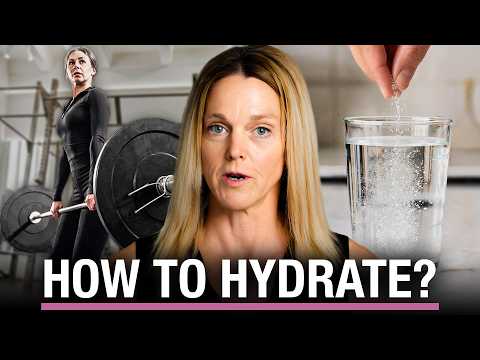
How Women Should Hydrate in Training: Sweat Rate, Sodium, Menstrual Cycle, and Perimenopause
~15 min
Episode Brief·YouTube

How Women Should Hydrate in Training: Sweat Rate, Sodium, Menstrual Cycle, and Perimenopause

Stacy Sims
Watch on YouTube Add to chat My bookmarks← All sources

TL;DR

The four things you'd lose by not watching

4 items

TL;DR

The four things you'd lose by not watching

4 items
1

Stacy Sims debunks hydration myths: 8 glasses a day is marketing, sports drinks are carbohydrate-centric (5–8%) not optimal for hydration (1–3% glucose-sodium solution), and sodium replacement is a marketing ploy — you only need a little sodium and sugar to pull water in.

2

Women have distinct hydration needs: they finish endurance races with lower blood sodium, risk hyponatremia in high hormone phases of the menstrual cycle, and perimenopause blunts thirst while increasing stress-induced fluid needs.

3

Practical strategies: for daily life, add ~200 mg sodium and a pinch of sugar to 16–20 oz water; for exercise up to 5 hours, add 1 tsp maple syrup with the sodium; over 5 hours, rely on food for potassium/magnesium; avoid chugging plain water gallons that kill thirst and promote overhydration.

4

Sweat sodium patches like those promoted by LMNT and Precision Hydration are misleading; the body can lose 50% of sodium stores without issue, and excess salt in sweat just reflects dietary surplus.

Protocols

Concrete recipes — what, when, how much, and why

4 items

Daily hydration for non‑exercisers (office workers)

WhatAdd about 1/16 teaspoon of salt (≈200 mg sodium) and a tiny pinch of sugar to 16–20 oz of water whenever drinking water without food.
WhenAnytime you are drinking water and not simultaneously eating a meal or snack; throughout the day as thirst dictates.
Dose~200 mg sodium (roughly 1/16 tsp salt) per 16–20 oz water; a pinch of sugar (just enough to activate co‑transport).
For whomAny woman (or person) drinking water without food, especially those prone to bloating or who feel thirsty despite drinking a lot.
WhyProvides luminal sodium and glucose needed for optimal water absorption in the small intestine, preventing bloating and the need for the body to pull its own sodium, thus faster and more efficient hydration.
CaveatsIf you are eating food that contains sodium and carbohydrates, plain water is fine; do not add extra salt if your meal already covers it. This is a minimal amount, not a replacement for dietary sodium.

Sims’s core argument is that plain water is not the body’s ideal hydration vehicle; the small intestine is sensitive and needs a small amount of salt and sugar to efficiently pull water into the bloodstream. This is especially relevant for women who experience bloating or gastrointestinal discomfort with large volumes of plain water. She references her PhD supervisor’s insight that drinking plain water kills the thirst stimulus upon first taste, so people stop drinking before they’ve actually absorbed enough. By pre‑loading the water with sodium and a touch of sugar, the absorption becomes faster and more comfortable, making hydration more effective even if one drinks less total volume. She emphasizes that this is not about sodium loading but about facilitating the physiological mechanism.

Mechanism

The small intestinal absorption of water relies on the co‑transport of sodium and glucose via SGLT1. Without luminal sodium and glucose, water absorption is delayed because the gut must secrete its own sodium to generate the osmotic gradient, which increases luminal pressure and can cause bloating. The added sodium and sugar provide the substrates directly, accelerating fluid uptake and preventing the premature suppression of thirst that occurs with plain water.

For the office worker that's hanging out, just adding maybe 1/16 of a teaspoon into 16 to 20 oz of water. So it's around 200 mg of sodium, but that's going to help actually pull the water in.

Also said
“if you're ingesting it with a little bit of sodium, it's already there, can be pulled in. So it's a faster way and you aren't changing your pressure within the small intestine so it actually works.”— Explains the benefit beyond just thirst.

Exercise hydration for sessions up to 5 hours

WhatAdd 1/16 teaspoon salt (~200 mg sodium) and 1 teaspoon maple syrup to 16–20 oz water; drink during exercise as needed.
WhenDuring any exercise session, from easy to moderate to high intensity, lasting up to 5 hours. Before/during the session.
Dose1/16 tsp salt + 1 tsp maple syrup per 16–20 oz of water; consume to thirst or planned sips based on duration.
For whomWomen (and men) doing any exercise up to 5 hours; especially useful for those who experience gut discomfort or bloating with plain water during workouts.
WhyExercise diverts blood flow away from the gut, reducing absorptive capacity. The combination of sodium and maple syrup (which contains sucrose, providing both glucose and fructose) activates all carbohydrate transport mechanisms (SGLT1 and GLUT5), maximizing water uptake and providing mild fuel without overloading carbohydrate.
CaveatsNo additional electrolytes (potassium, magnesium) are needed for these durations; they can be obtained from food afterwards. If training exceeds 5 hours or there are extreme conditions, consider food sources for those minerals. Maple syrup can be substituted with another source of sucrose, but the goal is to have both glucose and fructose present.

Sims notes that when we start exercising, we need a little more help because blood flow shifts to muscle. A teaspoon of maple syrup, which contains sucrose (a disaccharide that splits into glucose and fructose), activates all the fluid transport mechanisms. This is far more effective than plain water and avoids the high carbohydrate loads of commercial sports drinks that can sit in the stomach. She stresses that you don’t need a laundry list of electrolytes; the sodium plus the sugar is the key to hydration. The maple syrup also provides a small amount of fuel without trying to replace all the calories, which aligns with the idea that up to 5 hours, you can fuel with food. This protocol is flexible across weather patterns because the primary driver is fluid absorption, not sodium compensation for sweat.

Mechanism

During exercise, splanchnic blood flow decreases, reducing the efficiency of water and nutrient absorption. The presence of both glucose and fructose engages dual transport pathways (SGLT1 for glucose/galactose and GLUT5 for fructose), increasing the total absorptive capacity and pulling more water by osmotic coupling. Sodium remains critical for the SGLT1‑mediated transport. This simple solution avoids the hypertonicity of concentrated sports drinks and the gastric emptying delays they can cause.

When we start exercising, we have blood flow that gets diverted away from the gut cuz it goes to the muscles and we need a little bit more help. This is when we're looking at, 'Okay, so if I'm doing a relatively shorter easy session, maybe I'll add a little bit of maple syrup to that. Maybe a teaspoon of maple syrup with that sodium cuz maple syrup has both glucose and fructose.'

Also said
“We talk about potassium, that's more post exercise for rehydration or long endurance exercise when you start to have lots of fluid shifts. But you don't need all the other stuff.”— Reinforces that extra electrolytes are unnecessary during exercise.

Post‑exercise rehydration (potassium focus for long sessions)

WhatInclude potassium‑rich foods or a source of potassium (e.g., banana, potato, coconut water) after exercise, particularly if the session exceeded 5 hours or involved heavy sweating.
WhenWithin the post‑exercise recovery window, ideally with a meal or snack.
DoseNo specific dose given; general recommendation to incorporate potassium through whole foods.
For whomEndurance athletes, especially women, after long sessions (5+ hours) or in hot conditions.
WhyDuring long endurance exercise, fluid shifts and electrolyte losses can deplete potassium; post‑exercise rehydration is more effective when potassium is replenished to restore intracellular fluid balance.
CaveatsNot necessary for short or moderate‑duration workouts; food choices should guide rehydration rather than commercial electrolyte supplements.

We talk about potassium, that's more post exercise for rehydration or long endurance exercise when you start to have lots of fluid shifts.

Avoid overhydration: drink only to thirst and add sodium when drinking plain water

WhatDo not force down a gallon of water a day; drink when thirsty, and if drinking plain water without food, add a pinch of salt. Do not rely on clear urine as a sole hydration marker.
WhenThroughout daily life, except during exercise where thirst may be unreliable (then use salted/lightly sugared water).
DoseNo volume target; dictated by thirst and activity. If you must drink a lot, ensure sodium is present.
For whomAnyone, especially those who habitually carry a gallon jug or force hydration.
WhyGuzzling plain water suppresses thirst prematurely and leads to rapid urinary excretion without net hydration; adding sodium aids absorption and reduces the risk of hyponatremia from overdrinking plain water.
CaveatsDuring exercise, thirst may be blunted by palatization changes and blood flow redistribution, so rely on the pre‑mixed sodium/sugar drink rather than pure thirst. Always adjust based on sweat rate and environment, but avoid the dogma of drinking ahead of thirst.
Personal experience

Sims witnessed a professional baseball pitcher who, after being told to hydrate aggressively, drank gallons of water, developed hyponatremic symptoms (numbness, tingling), and collapsed after a game. This extreme case illustrates the danger of ignoring thirst regulation. Her own Kona race experience with hyponatremia due to plain water overconsumption also underpins this warning.

People are killing the thirst stimulus. As soon as you put water in your tongue, you kill the thirst stimulus so your body actually never really gets hydrated.

Also said
“you end up peeing it out. So you end up being more dehydrated than hydrated. You're flushing and everyone's like, 'Oh, I'm drinking all this water and my urine's really clear. I'm really hydrated, but yet I'm still thirsty.'”— Describes the paradoxical dehydration and diagnostic confusion.

What's new

Personal practice updates, fresh positions, predictions

5 items

hydration-myths-8-glasses-and-sodium-replacement

The 8-glasses-of-water-a-day rule and the obsession with electrolyte replacement for exercise are marketing constructs without solid science. Gatorade's evolution from a hydration aid to a carbohydrate drink illustrates how marketing overpowered original physiology.

Why this matters: Shifts the conversation away from dogmatic hydration rules and exposes the commercial distortion of sports hydration science, using the expert's direct PhD research background.

Background

Previously, hydration guidelines were dominated by the 8×8 rule (eight 8‑oz glasses) and sports drinks marketed as essential for electrolyte replenishment. The expert traces the origins of Gatorade, showing that the first formula was a low‑sugar, low‑salt solution recommended by a renal physiologist, but after corporate acquisition, carbohydrate was doubled and artificial sweeteners removed, shifting the product into a fueling drink. This reversed the narrative, making the 5–8% carbohydrate concentration standard despite evidence that 1–3% is optimal for plasma volume expansion.

Stacy Sims argues that two pervasive myths must be clarified: the 8–10 glasses of water daily, which like 10,000 steps was a marketing creation, and the idea that athletes must replace sodium aggressively with electrolyte drinks. She explains how Gatorade’s origin story involved a renal physiologist who suggested adding a little sugar and salt to help Florida football players, but once bought by a corporation, an artificial sweetener was added, then removed by the FDA, forcing them to double carbohydrate to maintain palatability. Research was then funded to prove it as a carbohydrate replacement with incidental hydration benefits, when the original data showed a 1–3% solution optimized plasma volume expansion. This historical inversion has led to an entire industry of high-carb, high-electrolyte products that are not primarily hydration tools. Sims says she’s been talking about sex differences in hydration for 20 years, and only recently is Gatorade launching a sex-difference research project. She sees the whole space as finally evolving.

Personal experience

Sims recounts that her entire PhD was on hydration and that she ‘had to go there’ because it’s her passion; she sees the same flawed narrative persisting and is excited that attention is shifting towards women-specific needs.

There are two myths that I need to bring up to clarify for everyone. First, when we talk about the 8 to 10 glasses of water a day, just like 10,000 steps is based on a marketing, right? So that's there's no real science behind it. And the other is this whole like electrolyte replacement sodium replacement idea, especially when we're talking about sports drinks. We have to think back to how it originated.

Also said
“Gatorade sits and all those sports drinks sit between 5 and 8% which is all about carbohydrate replacement. It's not about hydration.”— Directly contrasts marketing with physiological evidence.
“So again, it's marketing was stronger than science.”— Summarizes the overarching problem.

women-sex-differences-hydration-cycle-menopause

Women exhibit lower blood sodium after endurance events, face hyponatremia risk in high hormone phases of the menstrual cycle, and experience reduced thirst sensation during perimenopause and postmenopause, requiring higher baseline hydration.

Why this matters: Highlights a long-ignored area of sports science — menstrual cycle and menopausal effects on fluid homeostasis — that directly impacts female athletes’ safety and performance.

Background

Traditionally, hydration advice has been unisex, assuming similar sweat rates and sodium needs for men and women. Sims points out that research shows women finishing endurance races with normal or low blood sodium, while men finish with normal or high, indicating fundamental differences in fluid accumulation and sweat rate. She adds that the hormonal environment, especially high progesterone phases, alters fluid shifts and sodium handling, making women more susceptible to hyponatremia.

Sims explains that there are clear sex differences in sweat rate, fluid accumulation, and fluid shifts during exercise. Women who do long endurance races will finish with normal blood sodium or lower, whereas men will finish with normal or higher. This is due to differences in how fluid moves between compartments and how the body handles sodium. She then emphasizes that across the lifespan, during perimenopause and postmenopause, thirst sensation decreases, yet the body is under more stress and needs slightly more water. She is excited that Gatorade is finally launching a sex-difference research project, something she’s been advocating for two decades. Her personal story from the Kona Ironman illustrates the real danger: during her high-hormone phase, she drank plain water, became bloated and dizzy, then took an electrolyte tablet (Gastrolyte) and urinated excessively — classic hyponatremia. That experience led her to investigate and discover phase-specific sodium differences.

Personal experience

At the Kona turnaround, she got bloated and dizzy, consumed a Gastrolyte tablet (normally for GI distress), and then ‘had to pee like a racehorse.’ She realized she wasn’t taking in enough sodium and was drinking too much plain water, leading to hyponatremia — a risk heightened by being in the high hormone phase of her menstrual cycle. This fueled her PhD research.

hyponatremia is a risk for women, especially when you're in the high hormone phase of your menstrual cycle, which I was.

Also said
“When we hit peri and post menopause, our thirst sensation isn't as strong. But our hydration needs are a little bit higher cuz our bodies are more stressed.”— Adds lifespan context beyond the menstrual cycle.
“Women who do a long endurance race will finish with normal blood sodium or lower. And when we look at men, they'll finish with normal blood sodium or higher.”— Directly states the sex-based outcome difference.

plain-water-inefficiency-and-thirst-suppression

Drinking plain water without sodium and a little glucose is inefficient because the small intestine requires co-transport; chugging plain water also kills the thirst stimulus, leading to flushing and paradoxical dehydration.

Why this matters: Challenges the widespread belief that clear urine equals hydration, and provides a mechanistic reason why simply drinking more water can be counterproductive.

Background

Common advice is to drink water freely to stay hydrated, with clear urine as a marker. Sims counters that the small intestine’s absorption mechanism for water depends on sodium and glucose; without them, the body must pull its own sodium into the gut, slowing hydration. She also cites her PhD supervisor’s observation that sipping water suppresses thirst before adequate absorption, so constant drinking doesn’t fully hydrate.

Sims explains that fluid absorption in the small intestine is sensitive to pressure and requires a specific amount of glucose and sodium to pull water from the lumen into the body. If you drink plain water, the body has to first secrete sodium and glucose into the intestine to create the osmotic gradient, which is slower and can distort intestinal pressure, causing bloating. Adding a little sodium and sugar to the water supplies the co-transporters directly, enabling faster and more comfortable absorption. Moreover, her PhD supervisor noted that the moment water touches the tongue, the thirst stimulus is turned off, even if the body hasn’t actually absorbed enough fluid. This leads people to drink small amounts, kill thirst, but never truly hydrate. The extreme version is the gallon‑jug habit: the sheer volume overwhelms renal capacity, so it is rapidly excreted, making urine clear but leaving the body dehydrated. Sims states that people drinking gallons often report clear urine but persistent thirst, which is a sign that they are flushing out the water rather than absorbing it.

Personal experience

Sims’s former PhD supervisor, a hydration researcher, lamented that people are ‘killing the thirst stimulus’ by constantly sipping water, a phrase she now uses to explain why the gallon jug trend backfires.

People are killing the thirst stimulus. As soon as you put water in your tongue, you kill the thirst stimulus so your body actually never really gets hydrated.

Also said
“When you walk around and you're drinking all these gallons of water, you end up peeing it out. So you end up being more dehydrated than hydrated.”— Describes the paradoxical outcome of overdrinking.
“The small intestine is very sensitive because it takes a certain amount of pressure and certain amount of glucose and sodium to actually make everything work to pull fluid in.”— Physiological justification for adding sodium and sugar.

sports-drinks-carb-vs-hydration

Sports drinks at 5–8% carbohydrate concentration are designed for fuel delivery, not optimal hydration; the optimal solution for plasma expansion is 1–3% glucose-sodium.

Why this matters: Reframes how athletes should choose between hydration and fueling, potentially altering race-day nutrition strategies.

Sims revisits the Gatorade origin to show that the early research identified a 1–3% glucose‑sodium solution as ideal for increasing plasma volume — i.e., hydration. When the product was reformulated to taste better and later to replace lost carbohydrates, the concentration rose to 5–8%, which is still the standard for most sports drinks. Companies then funded studies to prove that this concentration was effective for carbohydrate replacement, effectively rebranding the product as a fuel source while retaining the hydration halo. For athletes, this means typical sports drinks are primarily sugar delivery systems, and relying on them for hydration can be suboptimal, especially if the athlete’s goal is fluid absorption rather than energy.

a 1 to 3% solution is optimal for plasma volume expansion which means hydration. But Gatorade sits and all those sports drinks sit between 5 and 8% which is all about carbohydrate replacement. It's not about hydration.

Also said
“they doubled the amount of carbohydrate to make it have the same pallet, then did research on it to show that it was a really good as a carbohydrate replacement and might help with hydration.”— Explains the reversal.

sweat-sodium-test-and-electrolyte-supplements-marketing

Sweat sodium patches are localized and don’t indicate whole-body sodium needs; the body can lose up to 50% of sodium stores without consequence, so commercial precision‑sodium products are oversold.

Why this matters: Directly criticizes popular brands like LMNT and Precision Hydration, providing athletes with a cost‑saving, science‑grounded alternative.

Sims asserts that sweat sodium testing is performed on a small patch of skin and does not represent whole‑body sodium requirements because sweat composition varies across body sites and over time. More importantly, humans have a large sodium reserve, and losing even half of it does not impair function. The marketing narrative that athletes must precisely replace sodium lost in sweat to avoid cramping or hyponatremia is, in her view, unfounded. Instead, adding a modest amount of sodium to fluid — just enough to facilitate absorption — is sufficient for nearly all exercise under five hours. She explicitly calls out LMNT and Precision Hydration as capitalizing on this fear, while noting that excess sodium is simply excreted in sweat and urine.

With sodium, there's no such thing as sodium replacement. So all the sweat sodium test, that's just a patch of what's happening under that exact patch, but that doesn't represent how much sodium your body needs. We can lose up to 50% of our sodium stores and be fine.

Also said
“I'll call them out because they're just banking on this whole like marketing idea of you have to replace all this sodium because if you don't, you're going to die. It's like, 'No, that's not how the body works.'”— Direct critique of LMNT and Precision Hydration.

Recommendations

Products, supplements, and tools mentioned in the episode

2 items

Homemade hydration mix: salt + sugar (or maple syrup) + water

Practice

Sims advocates using just sodium and a small carbohydrate source (e.g., maple syrup) instead of commercial sports drinks or electrolyte powders for hydration, because simple sugars and salt activate intestinal water transport without excess carbohydrate or unnecessary ions.

She positions this minimal approach against branded products like LMNT, Precision Hydration, and typical sports drinks, which she sees as over‑engineered and marketing‑driven. Her advice is to use table salt and maple syrup, which provides both glucose and fructose from sucrose. This homemade mix is effective, cheap, and avoids the palatization tricks that can delay gastric emptying. She also notes that for office workers, just salt and a pinch of sugar works; for exercise, adding maple syrup optimizes the system.

vs alternatives

Compared to commercial sports drinks (5–8% carbohydrate, optimized for fueling, not hydration), this homemade mix matches the optimal 1–3% solution for hydration. Compared to precision electrolyte supplements, it provides only the necessary sodium without excess potassium, magnesium, or the marketing narrative of sodium replacement. It also costs a fraction of the price.

Personal experience

Sims has used this approach in her own training and research, and it reflects the principles tested in her early hydration studies where a 1–3% glucose‑sodium solution maximized plasma volume expansion.

across the board, you just need a little bit of sugar and a little bit of salt in your water.

Also said
“you don't need all the other stuff.”— Simplicity over multi‑ingredient products.
Find Homemade

Avoid precision electrolyte supplements for routine hydration

Practice

Sims explicitly criticizes LMNT and Precision Hydration, stating they profit from the myth that athletes must replace sweat sodium to avoid harm; she advises against using them for ordinary hydration needs.

She argues that the body has a large sodium reserve (50% can be lost without functional impairment) and that sweat sodium measurements are localized and unrepresentative. Products that encourage users to tailor sodium intake to sweat test results are, in her view, exploiting fear. For up to five hours of exercise, a little sodium in water is sufficient; extra electrolytes just get excreted. This recommendation is to save money and avoid the stress of micromanaging electrolyte intake.

vs alternatives

Alternative is the homemade salt‑sugar‑water mix described above, or simply relying on food for potassium and magnesium after exercise. This is both physiologically sound and far less expensive.

I'll call them out because they're just banking on this whole like marketing idea of you have to replace all this sodium because if you don't, you're going to die. It's like, 'No, that's not how the body works.'

Find Avoid

Notable quotes

Lines worth pulling out — contrarian, specific, or perfectly phrased

5 items
People are killing the thirst stimulus. As soon as you put water in your tongue, you kill the thirst stimulus so your body actually never really gets hydrated.
Crisp, counterintuitive statement that undermines the ‘drink more water’ dogma.
a 1 to 3% solution is optimal for plasma volume expansion which means hydration. But Gatorade sits and all those sports drinks sit between 5 and 8% which is all about carbohydrate replacement. It's not about hydration.
Clear numerical contrast that exposes the mismatch between marketing and physiology.
With sodium, there's no such thing as sodium replacement. So all the sweat sodium test, that's just a patch of what's happening under that exact patch, but that doesn't represent how much sodium your body needs. We can lose up to 50% of our sodium stores and be fine.
Direct challenge to the burgeoning sweat‑testing industry and products like LMNT.
I had to pee like a racehorse. And it's because I wasn't having enough sodium. I was just drinking a lot of the water cuz I was so thirsty and so like hyponatremia is a risk for women, especially when you're in the high hormone phase of your menstrual cycle, which I was.
Vivid personal anecdote linking menstrual cycle phase to real hyponatremia risk; makes the science tangible.
You're going to have be a sweaty a salty sweater if you use that stuff, but that doesn't mean that you need more salt. It means that you're sweating out the extra stuff your body doesn't need.
Pithy explanation that high sweat sodium reflects excess intake, not a deficiency.

Sign in to share feedback

Tell us if this brief hit the mark or missed it — feedback feeds back into the next iteration of the prompt.

Topics covered

hydration-mythsgatorade-historysports-drink-carbohydrate-vs-hydrationwomen-sex-differences-hydrationmenstrual-cycle-hyponatremiaperimenopause-thirstfluid-absorption-small-intestinesodium-glucose-co-transportplain-water-inefficiencythirst-stimulus-suppressionoverhydration-hyponatremiasweat-sodium-test-inaccuracyelectrolyte-marketing-critiquelmnt-precision-hydration-criticismhomemade-hydration-protocolmaple-syrup-exercise-hydrationpost-exercise-potassiumgastrolyte-emergency-usekona-hyponatremia-story
Free account

Make this library yours

Reading is free for everyone. A free account adds the personal layer: save protocols, follow experts, and see how the other experts weigh in on this same topic.

Create a free accountSign in

Where the experts disagree — weekly

One email a week: the sharpest new disagreements and protocols from the library. No spam, unsubscribe anytime.

Educational summary of the cited expert source — not medical advice. Open the source recording linked above and consult a qualified physician before acting on any protocol.