
UNFUCG
DashboardSearchChatBookmarksNotificationsActivityPremiumProfile
?
Home
Search
Chat
Saved
Profile
Episode
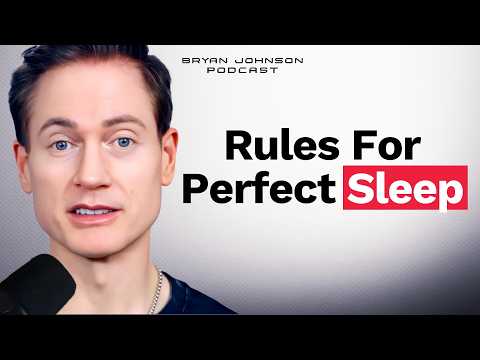
My Advanced Guide To Better Sleep | Bryan Johnson Podcast
~74 min
Episode Brief·YouTube

My Advanced Guide To Better Sleep | Bryan Johnson Podcast

Bryan Johnson
Watch on YouTube Add to chat My bookmarks← All sources

TL;DR

The four things you'd lose by not watching

4 items

TL;DR

The four things you'd lose by not watching

4 items
1

Bryan Johnson frames sleep as the #1 performance-enhancing drug and argues your pre-bed resting heart rate (not your sleeping low) is the single most actionable metric — he targets ~44 bpm at head-on-pillow and structures his entire day around lowering it.

2

His 8-months-of-perfect-sleep run was built on rigid consistency: 8:30 PM bedtime ±1 minute, last meal ~8 hours before bed, 30-60 min screen-free wind-down, and red/amber lights only in the evening.

3

A Kernel N=1 study on himself showed that when his deep sleep dropped from ~90-120 min to 35-45 min, willpower (measured by a go/no-go impulse-control task) collapsed — directly linking one bad night to next-day vice decisions.

4

Practical challenge: get a baseline pre-bed resting heart rate tonight and aim to drop it 10% within 30 days by pattern-matching what raises vs. lowers it (late meals, alcohol, intense TV, fights, screens all push it up).

Protocols

Concrete recipes — what, when, how much, and why

8 items

The 10-Step Sleep Protocol

WhatJohnson's condensed 10-tip framework for high-quality sleep: 1) adopt 'professional sleeper' identity, 2) last meal ≥4 hours before bed, 3) 30-60 min screen-free wind-down, 4) morning light within ~5-30 min of waking, 5) consistent bedtime ±minutes, 6) caffeine cutoff accounting for 6-hour half-life, 7) red/amber lights at night, no blue, 8) cool room (69-71°F), 9) quiet sleep environment, 10) wearable to build personal intuitions.
WhenDaily, structured around a fixed bedtime
DoseJohnson personally: last meal ~8 hours before bed; 30-60 min wind-down; bedtime 8:30 PM ±1 min during his 8-month perfect-sleep run
For whomAnyone wanting to systematically improve sleep without pharmaceuticals
WhyAll ten levers ultimately serve to lower pre-bed resting heart rate, which determines sleep quality.
CaveatsSevere insomnia may still require professional help; give the body a few weeks to adjust to new rhythms before judging.

Johnson's framing is that no one is ever formally taught how to sleep — there's no school course on it despite it being fundamental. His protocol is designed to replace the cultural default ('just lie down and hope') with the same rigor people apply to a job or a hobby. The 'professional sleeper' identity is the keystone: if you treat being 4 minutes late to a 10 PM bedtime with the same self-respect you'd treat being 4 minutes late to a 9 AM meeting, all the other behaviors fall into place.

He stresses that this is lifestyle-and-habits work, not a supplement-and-therapy stack. The 10% pre-bed HR reduction in 30 days is the proposed accountability mechanism — a concrete, measurable target that forces you to discover which of these ten levers matter most for you specifically.

The wind-down block is the piece he emphasizes most heavily: screens off, book in hand (he cites evidence that reading is as efficacious as a sleep pill), walking, meditation, breath work, or calling a friend. He acknowledges screen addiction as the main barrier and says you have to consciously acknowledge it.

Mechanism

Each lever reduces sympathetic nervous system activation before sleep. Food digestion raises HR; caffeine (6-hr half-life) keeps adenosine receptors blocked; blue light suppresses melatonin; warm temps prevent the core body temp drop that initiates sleep; inconsistent timing disrupts the circadian rhythm that the morning light pulse anchors.

Personal experience

During his 8-month perfect-sleep stretch, Johnson was in bed at 8:30 PM within a 1-minute window every night and would 'fall asleep instantaneously' — he attributes this to the body's response to consistency.

If you also believe that sleep will be make you more successful in everything you do then it justifies and that is very counter to our current culture where people say sleep doesn't matter and actually successful people don't sleep. That's a ridiculous idea.

Also said
“Evidence shows that a book in hand, for example, is as efficacious as a sleep pill.”— Specific claim about the wind-down lever's potency.
“When I was achieving 8 months of perfect sleep, my bedtime was 8:30 p.m. I was in bed plus or minus like 1 minute every night.”— Quantifies the consistency target.

Pre-bed resting heart rate measurement

WhatLie down, take a few deep breaths, then either read the value off a wearable or count your pulse at the neck for 6 seconds and multiply by 10. Track it nightly.
WhenEvery night, just after getting into bed
DoseGet a baseline tonight; aim for a 10% reduction in 30 days
For whomAnyone trying to systematically improve sleep; Johnson specifically pitches it to people overwhelmed by the complexity of health advice.
WhyPre-bed HR is the single most actionable proxy for sleep quality and the day's choices.
CaveatsCan create anxiety/sleep-anxiety loop for some people, particularly those prone to rumination — Kate explicitly raised this risk and Johnson acknowledged it.

Johnson positions this as a simplification device for the overwhelmed: rather than debating seed oils, cholesterol, or what kind of fat to eat, anchor on one number you control. Whatever raises your pre-bed HR is bad; whatever lowers it is good. He says the most common report from people who get wearables is 'I saw that alcohol wrecks my sleep' — proof that the measurement-then-pattern-match loop works.

He shows an on-screen reference for typical HR impacts: alcohol before bed adds 5-10 bpm; anxiety/stress/rumination adds 5-25 bpm (the largest); late-night exercise adds 4-10 bpm. These give people a sense of magnitude when troubleshooting their own number.

The 10% in 30 days target is calibrated to most people, who Johnson believes have substantial low-hanging fruit. Kate notes that for someone already dialed in (like herself), shifting HR by even 2 beats can take six months — so this is a starter goal, not a steady-state target.

Mechanism

Resting heart rate tracks parasympathetic vs. sympathetic balance. A lower HR means the parasympathetic ('rest and relax') branch is dominant, the prerequisite state for sleep onset and deep sleep architecture.

Personal experience

Johnson is at ~46-47 bpm on the pillow, dropping to 44 once his head is down and 42 as his overnight low — a gap of only ~3-4 bpm that Mike calls remarkable.

Where you can find stability where you can anchor your boat is your resting heart rate before bed. That is where you can find peace and comfort and control.

Also said
“I can calm my heart rate down in like 60 seconds, but a longer duration time like if you're aroused from watching a movie or from having a fight or from working... it's going to take you 30 to 60 minutes to calm your body down.”— Specifies the practical timing of the calm-down lever, which sets the wind-down duration.

Morning light exposure

WhatGet bright light within ~5-30 minutes of waking — either sunlight or, if waking before dawn, a 10,000 lux indoor lamp.
WhenImmediately upon waking
DoseWindow of 20-30 minutes; Johnson personally aims for within 5 minutes
For whomEveryone
WhySets the circadian rhythm and triggers downstream processes the body needs for the day/night cycle.
Personal experience

Johnson wakes around 4:30 AM, before sunrise, so he uses a 10,000 lux light in his home rather than going outside.

I wake up before the sun rises around 4:30 a.m. So, I use a 10,000 lux light in my home.

Phone out of the bedroom

WhatPhysically plug your phone in away from the bed — ideally in another room or at minimum across the room.
WhenAt the start of the wind-down routine
For whomAnyone who can't resist their phone at night (i.e., most people)
WhyRemoves the temptation to check 'just one more time' before sleep.

If you plug it in in a different room or in the other side of the room, you're much less likely to be drawn to that phone.

Evening journaling

WhatPen-on-paper journaling as part of the wind-down — worries, gratitude, or just the day's events.
WhenDuring the 30-60 min wind-down block
For whomAnyone, especially people who ruminate at night
WhyHelps offload anxiety from the day and creates a physical/mental transition into the sleep environment.

There's something like really I don't know connecting about just putting a pen on paper just like holding a book in your hand. And I think that it allows people to like put down some of that anxiety from the day.

CBT-I stimulus control: bed = sex + sleep only

WhatReserve the bed exclusively for sex and sleep — no reading, scrolling, working, or watching in bed.
WhenOngoing
For whomEspecially people with insomnia (waking in the middle of the night, can't fall asleep), but beneficial for anyone.
WhyTrains the brain to associate the bed with sleep onset, useful both clinically for insomnia and as general hygiene.

Mike introduces this as a tool from CBT-I (cognitive behavioral therapy for insomnia), the evidence-based first-line behavioral treatment for chronic insomnia. The mechanism is classical conditioning — if the bed is only ever paired with sleep (and sex), the brain stops associating it with the alertness of work, scrolling, or worrying, and sleep onset gets faster.

Bed is reserved for sex and sleep. And you literally do nothing in your bed except for have sex and go to sleep.

Cool sleep environment

WhatKeep bedroom around 69-71°F (20.5-21.5°C).
WhenOvernight
Dose69-71°F
For whomEveryone
WhySleeping hot is disruptive; cooler temps support sleep architecture.
Personal experience

Johnson uses a temperature-controlled mattress (Eight Sleep) to modulate temperature through the night.

Your body is going to do better with a temperature around you know 69 to 71 Fahrenheit thereabouts.

Caffeine timing for 6-hour half-life

WhatStop caffeine early enough that the remaining dose at bedtime is acceptable. A 4 PM coffee leaves half a cup of caffeine in your system at 10 PM.
WhenThroughout the day, with attention to the cutoff
DoseRoughly 6-hour half-life (varies by individual)
For whomAnyone consuming caffeine; also applies to other stimulants like modafinil and ADHD medications.
WhyResidual caffeine elevates HR and disrupts sleep architecture.
CaveatsMetabolism rate varies significantly between individuals.

A cup of coffee at 4 p.m. leaves a half a cup of coffee of caffeine in your body by 10 p.m. because there's roughly a 6-hour halfife.

What's new

Personal practice updates, fresh positions, predictions

4 items

Pre-bed resting heart rate as the master sleep metric (vs. sleeping low)

middle third

Johnson argues the heart rate you have right as you put your head on the pillow is a better indicator of sleep quality than the lowest heart rate captured during sleep, because it reflects how well you executed your day.

Why this matters: Most wearables (Whoop, Oura) emphasize the overnight low; Johnson is reframing the meaningful number as the pre-sleep value, which is something the user can actually act on.

Background

Standard wearable culture trains people to look at the morning recovery/readiness score, which arrives after the fact and can produce anxiety without giving them an actionable lever during the day.

Johnson's claim is that pre-sleep resting heart rate is essentially a scorecard for the day's behaviors — what you ate, when you ate, whether you fought with your partner, whether you worked until lights out, whether you watched something arousing. Because the body takes 30-60 minutes to come down from sympathetic activation, the number on the pillow is a near-deterministic forecast of how the night will go. He says his own readings are so stable he can predict REM, deep, and stress scores from that single data point.

Mike Mallin extends the argument: pre-sleep HR measures preparation for sleep, while overnight low measures execution. The gap between them (Johnson's is only ~3-4 bpm: 46-47 on the pillow vs. 42 overnight) is itself a signal of how well-followed the daily protocol was. A wider gap implies more sympathetic carryover into the night.

Kate flags the counter-risk: for anxious or insomnia-prone people, seeing an elevated number before bed can create a self-fulfilling loop of bad sleep. Johnson concedes the risk but says after years of tracking he's so pattern-matched that the number feels descriptive rather than prescriptive.

Personal experience

Tuesday night in Las Vegas, Johnson ate dinner at 4-5 PM after an emergency disrupted his day, checked his pre-bed HR and saw 53 bpm vs. his typical 46-47, told Kate it was going to be a bad night, and it was. He's still feeling the headache from that one night two days later.

What it's showing is it's showing how prepared you are for sleep rather than how successfully you slept.

Also said
“My sleep depends upon my resting heart rate before bed. And so I've tried to structure my entire life around this idea of things that increase my resting heart rate are bad.”— States the core thesis — pre-bed HR is the organizing principle of his entire daily protocol.
“I think last night I was 42... So maybe like you are 3 to four points above your actual resting heart rate. That I think that's pretty remarkable.”— Quantifies the unusually narrow gap between his pre-sleep and overnight HR — the target state.

Updated rule: skip the meal rather than eat late

middle

After his Vegas experiment, Johnson is updating his protocol to a hard cutoff (noon-1 PM if needed) — if he can't eat by then, he'll just go hungry rather than pick up calories later.

Why this matters: This is a live update to his own protocol prompted by recent data, and contradicts the more common advice to 'just eat earlier when possible.'

Johnson frames this as part of his constant re-testing of Blueprint assumptions — checking whether things that were true a year ago (e.g., that his cardiovascular fitness gains from sauna would let him tolerate a later meal) still hold. The Vegas night, where even a clean meal of hummus and raw vegetables at 4-5 PM wrecked his sleep and left him with a two-day recovery period including a headache, convinced him that no meal is worth the downstream cost. The asymmetry — one bad night, multiple days to recover — makes the calorie tradeoff irrational for him.

Personal experience

He and Kate flew to Vegas Monday with half their calories packed; unexpected emergencies meant they couldn't source the other half until 4-5 PM. He 'rolled the dice' and ate; even with clean foods his HR stayed elevated and his sleep was wrecked.

I would rather go hungry and miss out on some calories for the day than I would try to pick up the calories later in the day.

Also said
“Even though last night was a great night's sleep, it takes you a couple days to recover from a really bad night's sleep.”— Justifies the asymmetric tradeoff — one indulgence costs multiple days.

Sleeping separately from your partner

late

Kate recommends sleeping in a separate bed (or at least separate bed in same room) from a partner as a high-impact, under-discussed sleep upgrade.

Why this matters: Cuts against strong cultural stigma that separate sleeping signals relationship trouble.

Kate frames this as the most painful suggestion on the list because of social baggage — Mike admits he has a mental block tied to childhood memories of grandparents sleeping in separate rooms and associating it with their relationship deteriorating. Kate says she had the same perception initially but found that once she tried it, 'nothing changed about the relationship and you have better quality sleep.' She acknowledges some people genuinely sleep better paired (asynchronous sleep cycles affect people differently in the data) but pushes a trial period as the only way to know.

Personal experience

Mike tried it for about a month after shoulder surgery but says he was in an uncomfortable bed without his Eight Sleep, so the test wasn't fair. His wife has told him directly that he disrupts her sleep.

I will say that has made an enormous difference in my life. And so if you can, even if it's just another bed in the same room, if you can sleep separately to your partner, I would highly encourage it.

Also said
“Once you start doing it, it's like, oh, nothing changed about the relationship and you have better quality sleep.”— Directly addresses the stigma that's the main barrier to trying it.

Sleep as first-line treatment for mood disorders

late

Johnson asserts the same protocol is also the first-line defense for depression and anxiety, and that turning to a pill skips the basic biological repair work sleep provides.

Why this matters: Positions sleep against the pharmaceutical-first cultural default for mental health.

Personal experience

Johnson mentions having been depressed and overeating to address depressive symptoms, and notes that depression itself makes sleep hard, creating a complicated cycle.

The best protocol to address first line of defense for depression and anxiety is to nail your sleep.

Recommendations

Products, supplements, and tools mentioned in the episode

6 items

Eight Sleep (temperature-controlled mattress)

Product

Johnson uses it to modulate his temperature throughout the night to hit the 69-71°F target.

Personal experience

Johnson uses it nightly; Mike mentions missing it when he tried sleeping in a separate bed after shoulder surgery.

I use a temperature controlled mattress in asleep which uh really is very useful to modulate my temperature throughout the night.

Find Eight

10,000 lux indoor light

Product

For people who wake before sunrise — Johnson wakes at 4:30 AM and uses one to get morning light.

vs alternatives

Direct sunlight is the alternative if you wake after sunrise.

Personal experience

Used daily in his home before dawn.

I wake up before the sun rises around 4:30 a.m. So, I use a 10,000 lux light in my home.

Find 10,000

f.lux (blue light filter for browsers/screens)

Tool

Software to strip blue light from screens in the evening if you must use them.

vs alternatives

Also mentions using iOS/device 'red mode' as an alternative.

There's tools like Flux F. Lux that you can have on a browser that kills the blue light.

Find f.lux

Sleep wearables (Apple Watch, Oura, Whoop)

Product

For tracking pre-bed and overnight HR, HRV, and building personal intuitions about which behaviors affect sleep.

vs alternatives

He says 'they're all good' — doesn't endorse one over another. For people without a wearable, he gives the manual neck-pulse method (count beats for 6 seconds, multiply by 10).

Personal experience

Johnson used a wearable to track his 8 months of perfect sleep. Notes that the most common insight people get is 'alcohol wrecks my sleep.'

You can have a wearable where you use Apple Watch, Aura, Whoop. Uh they're all good. And just so you create intuitions on what things you do in life and how those relate to your sleep quality.

Find Sleep

CBT-I (Cognitive Behavioral Therapy for Insomnia)

Practice

Mike recommends this as the evidence-based intervention for true insomnia — people who can't fall asleep or who wake in the middle of the night.

vs alternatives

Implicitly compared to sleep pills — Johnson notes 'in American society when something is wrong we turn to a pill,' and CBT-I is the behavioral alternative.

Something called CBTI, which is cognitive behavioral therapy for insomnia... that is a really helpful thing for people who have true insomnia.

Find CBT-I

Red/amber lighting and device red-mode

Tool

Replace blue-spectrum evening light to avoid suppressing melatonin.

Have blue uh I'm sorry, have red and amber lights. Turn off blues.

Find Red/amber

Notable quotes

Lines worth pulling out — contrarian, specific, or perfectly phrased

6 items
If you realize sleep is the number one performance-enhancing drug. It's there's no more powerful drug in the world you can take on a daily basis. Then it's worth prioritizing your life around sleep.
The core thesis of the episode and Johnson's framing for why every other lifestyle decision should defer to sleep.
If the meeting begins at 9:00 a.m. and you show up at 9:04, you typically acknowledge the group and say, I'm sorry for being late... Now, when if your bedtime is 10 p.m. and you go to bed at 10:04 p.m., it's not customary that you apologize to yourself for being late.
The 'professional sleeper' analogy in its sharpest form — a concrete behavioral norm people can apply immediately.
Where you can find stability where you can anchor your boat is your resting heart rate before bed. That is where you can find peace and comfort and control.
Captures Johnson's pitch for collapsing the complexity of health into one controllable number.
It's like a pre-sleep Brian that exists during this windown routine that is a form of sleeping in a way.
Kate's observation that Johnson's wind-down routine essentially extends sleep backwards into the evening — a memorable reframe of what 'preparing for bed' means.
People who are successful who don't sleep could be more successful if they slept. They're successful despite their lack of sleep.
Direct shot at the hustle-culture narrative that sleep deprivation correlates with success.
Gosh, you like I just wish somebody would have been in my life to tell me these things. I don't know why did I have to navigate this for 20 years by myself.
Unusually personal closing — Johnson framing the entire protocol as the thing he wishes someone had told him decades ago.

Sign in to share feedback

Tell us if this brief hit the mark or missed it — feedback feeds back into the next iteration of the prompt.

Topics covered

pre-bed-heart-rateprofessional-sleeper-mindsetwind-down-routinemeal-timingwillpower-deep-sleepsleep-deprivation-doctorscaffeine-half-lifemorning-lightblue-light-eveningcool-bedroomconsistent-bedtimeseparate-bed-partnercbt-insomniawearablessleep-mood-disorders
Free account

Make this library yours

Reading is free for everyone. A free account adds the personal layer: save protocols, follow experts, and see how the other experts weigh in on this same topic.

Create a free accountSign in

Where the experts disagree — weekly

One email a week: the sharpest new disagreements and protocols from the library. No spam, unsubscribe anytime.

Educational summary of the cited expert source — not medical advice. Open the source recording linked above and consult a qualified physician before acting on any protocol.