
UNFUCG
DashboardSearchChatBookmarksNotificationsActivityPremiumProfile
?
Home
Search
Chat
Saved
Profile
Episode
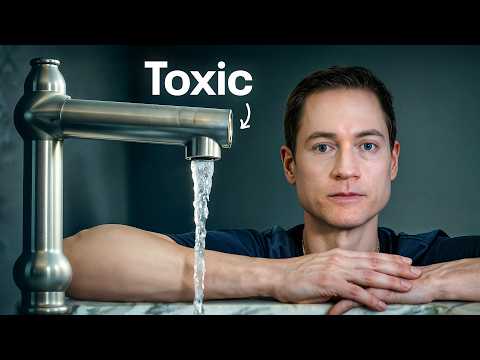
Your House Is Making You Sick (15 Solutions)
~19 min
Episode Brief·YouTube

Your House Is Making You Sick (15 Solutions)

Bryan Johnson
Watch on YouTube Add to chat My bookmarks← All sources

TL;DR

The four things you'd lose by not watching

4 items

TL;DR

The four things you'd lose by not watching

4 items
1

Removing shoes at the door stops 85% of outdoor contaminants (lead, pesticides) from entering the home — the simplest, highest-impact step.

2

Upgrading to a MERV 13 HVAC filter can capture far more PM2.5 than a standard MERV 8; use an air quality monitor to see the improvement within minutes.

3

A reverse osmosis water filtration system reduces dissolved solids from >300 mg/L to near zero and should be tested monthly to verify safety.

4

Complete bedroom blackout is critical — just 10 lux of light can halve melatonin — and using a dim red light two hours before bed protects sleep architecture.

Protocols

Concrete recipes — what, when, how much, and why

10 items

Shoe removal at entry

WhatTake off shoes at the door before entering the main living space.
WhenEvery time you enter the home.
For whomEveryone.
WhyThe first four steps inside the house track 85% of outside contaminants including lead and pesticides.

Bryan explains that once these contaminants are inside, they are far more likely to be ingested or inhaled by occupants. He emphasizes that this simple habit stops a major influx of toxins that would otherwise settle in the home.

The first four steps inside the house tracks 85% of the outside world's contaminants includes leads and pesticides.

Also said
“Once this stuff is inside your house, it's far more likely to get inside you and your family's bodies.”— Reinforces the health implication.

High-efficiency HVAC filter (MERV 13)

WhatInstall a MERV 13 (or highest rating your system can handle) in your HVAC system.
WhenReplace regularly; use continuously.
DoseMERV 13 if compatible, otherwise the highest possible MERV rating.
For whomAnyone with a central HVAC system; check compatibility with an HVAC technician.
WhyA MERV 8 captures only ~30% of PM2.5; higher MERV ratings capture much more, dramatically improving whole‑house air quality.
CaveatsDo not exceed the MERV rating your system is designed for, as it can cause airflow problems. Consult an HVAC technician if unsure.

Bryan demonstrates his MERV 13 filter and explains that it is his primary air‑quality defense. He pairs it with air quality monitors to verify effectiveness, noting that after installing a better filter, he can see the difference within minutes on his PM2.5 sensors. He stresses that a good HVAC filter is a 'set and forget' system that runs on autopilot, solving the problem without daily effort.

Mechanism

The filter's dense media traps fine particles like PM2.5, which are inhalable particles linked to cardiovascular and respiratory harm.

Personal experience

He says, 'The air filters are a nice add-on, but really your HVAC system should be your first line of defense for air quality. If you use an air quality monitor, you'll notice the difference within minutes.'

A Merv 8 is only going to capture about 30% of PM 2.5. So, the higher you can go, the better, but don't go higher than your system is rated.

Also said
“For this particular HVAC system, it can handle a Merv 13, but not all HVAC systems can handle that much.”— Adds the important caveat about compatibility.

Indoor air quality monitoring

WhatUse a sensor that measures PM2.5, VOCs, CO2, and AQI to continuously track air quality.
WhenPlace in main living areas and bedroom; leave running.
For whomAnyone concerned about indoor pollution, especially those with allergies or asthma.
WhyReal‑time pollutant data allows you to verify that air purifiers and HVAC filters are working, and identify when outdoor air is poor.
CaveatsMonitors vary in the pollutants they measure; choose one that includes PM2.5 and VOCs at minimum.

Bryan shows his two monitors: one dedicated to PM2.5, PM1, PM10, VOCs, and another that gives a general AQI and CO2. He demonstrates that after a gathering CO2 is elevated, and he can compare indoor vs outdoor air quality. This data helps him decide whether to run purifiers, adjust ventilation, or change filters. He treats it as an essential feedback loop for his automated health system.

Mechanism

PM2.5 refers to fine particles that penetrate deep into lungs; VOCs can react to form formaldehyde; high CO2 indicates inadequate ventilation.

Personal experience

He says, 'These are really nice in that they give me a constant recording of the air quality inside the home. That allows me to know if my air purifiers are working and as we'll get to later, the filter in my HVAC system.'

I have two monitors. For example, this guy gives you something called PM2.5. That's a particular kind of toxin, and I want to know what it is. There's also PM1, PM10. I see VOCC's on this one.

Radon detection

WhatTest your home for radon and install a radon detector to monitor levels.
WhenTest initially, then press the test button monthly.
For whomEveryone, particularly those in areas with known radon risk.
WhyRadon is an invisible, odorless gas that is the second leading cause of lung cancer after smoking.
CaveatsRadon levels vary geographically; follow up with professional mitigation if high.

Bryan stresses that radon is a meaningful, often overlooked risk because it emanates from the earth and accumulates in homes. He mentions that despite having smoke and CO detectors, radon requires a specific test. He encourages pressing the test button monthly to ensure protection.

Mechanism

Radon gas decays into radioactive particles that can damage lung tissue, increasing cancer risk.

It's actually the second most prominent cause of lung cancer behind smoking.

Also said
“Press that test button once a month, listen for the beep, and you'll know you're protected.”— Provides the simple habit to maintain safety.

Reverse osmosis water filtration

WhatInstall an under-sink reverse osmosis system to filter tap water.
WhenReplace filters every few months; test water quality monthly.
For whomAnyone concerned about water contaminants.
WhyTap water can contain heavy metals, PFAS, microplastics, and other dissolved solids; RO reduces total dissolved solids to near zero.
CaveatsSystems cost a few hundred to over a thousand dollars; require periodic filter changes and may waste some water.

Bryan lives in Los Angeles and notes that despite good municipal water, contaminants can still appear, especially after large‑scale fires. He shows his RO system and a data sheet tracking monthly tests. Tap water showed more than 300 mg/L dissolved solids, while RO water drops to almost nothing. He emphasizes that lab testing gives him confidence in what he drinks.

Mechanism

The semi‑permeable membrane physically blocks contaminants larger than water molecules, including many heavy metals and organic compounds.

Personal experience

He says, 'I've been testing the water out of my tap for years. … Straight from the tap, you get over 300 mg of dissolved substances. With reverse osmosis, that drops to almost nothing.'

If you get a good water filtration system, these reverse osmosis systems cost between a few hundred to over a thousand, but the water's clean. We test it every month.

Replace non-stick pans with PFAS-free cookware

WhatDiscard non-stick pans and use stainless steel or cast iron to avoid PFAS 'forever chemicals'.
WhenImmediately.
For whomAll home cooks.
WhyNon-stick coatings can contain PFAS, which are persistent, bioaccumulative, and linked to health problems.
CaveatsStainless steel and cast iron require different cooking techniques (e.g., seasoning, oil).

Bryan points out that many pans have PFAS, which he calls 'really bad chemicals' that you don't want in your body. He shows his food‑grade stainless steel pan and notes cast iron as another safe alternative. This fits his larger mission to eliminate plastics and toxic materials from the kitchen.

Mechanism

PFAS are resistant to degradation, accumulate in the body, and have been associated with immune, thyroid, and developmental issues.

You want to specifically avoid non-stick pans. They can have PAS. These are forever chemicals. They're really bad chemicals.

Also said
“One way to avoid that is to use a material that does not have PAS. This, for example, is food grade stainless steel. You could also use cast iron.”— Offers immediate alternatives.

Dim red light 2 hours before bed

WhatUse a dim red LED lamp in the evening, starting 2 hours before bed, to replace bright white/blue light.
WhenTwo hours before bed, and throughout the night if light is needed.
DoseAs needed; keep it dim, just enough to navigate.
For whomAnyone wanting to improve sleep onset and quality.
WhyBlue/white light suppresses melatonin and delays sleep; red light does not, helping the body wind down.
CaveatsEnsure the bulb is truly red (not just colored red) and stays dim; avoid looking directly at bright lights.

Bryan has a low‑cost (~$30) red lamp that he turns on at dusk. He rarely uses other lights because his home has good natural light. He describes the red light as soothing, cool, and a signal to the body that it is time to prepare for sleep. He recommends trying a dim red LED in the living room to help with circadian rhythms.

Mechanism

Melatonin secretion is inhibited by short‑wavelength light (blue) via ipRGC photoreceptors; red light has minimal effect.

Personal experience

He says, 'I have nice natural light in the home. So, I rarely turn on lights in the house at all. But at night, when it's getting dark, I'll turn this guy on. It's enough light to navigate the house. It's a really cool vibe. It's soothing. It's calming.'

Try using a dim red LED in your living room and do so 2 hours before bed. It will help your body wind down and prepare for sleep.

Complete bedroom blackout

WhatEliminate all light in the bedroom during sleep, using blackout curtains or an eye mask.
WhenDuring sleep hours.
DoseComplete darkness; even 10 lux is problematic.
For whomAnyone struggling with sleep quality or morning grogginess.
WhyLight as low as 10 lux can halve melatonin production and fragment sleep, reducing sleep quality.
CaveatsIf a completely dark room is not feasible, use a well‑fitting eye mask as an alternative.

Bryan's bedroom is entirely blacked out with no light entry. He says his sleep quality dramatically improved when he eliminated all light sources. He acknowledges that not everyone can dedicate a room solely to sleep, so he suggests eye masks as a practical workaround.

Mechanism

Even dim light detected through closed eyelids can disrupt circadian signals and suppress melatonin, leading to lighter, more fragmented sleep.

Personal experience

He says, 'I've noticed in my own testing of the various places I've slept, either hotel rooms or bedrooms, a blacked out bedroom substantially improves sleep quality.'

To illustrate how sensitive your body is to light, even 10 lux of light can half your melatonin production and fragment your sleep.

Pink noise machine

WhatUse a pink noise machine to smooth out disruptive noises while sleeping.
WhenDuring sleep, particularly if external noises are erratic.
DosePlay continuously at a low, steady volume.
For whomLight sleepers, people in noisy neighborhoods, or those sensitive to sudden sounds.
WhyPink noise has a softer, more natural sound (like rustling leaves) that can mask sudden noises and improve sleep continuity.
CaveatsEffectiveness can vary; not a robustly studied intervention. Measure your sleep quality to confirm it works for you.

Bryan started using a noise machine when living in a noisy apartment next to a road with loud motorcycles and cars; it helped smooth out the noise spikes and improved his sleep. Now in a quiet house, he still uses it because occasional dog barks still occur. He favors pink noise over white or brown because it's less high‑pitched and more pleasant. He cautions that it is a personal experiment and advises using sleep metrics to assess benefit.

Mechanism

Pink noise has equal power per octave, reducing the jarring impact of sudden loud sounds by providing a consistent auditory backdrop, potentially reducing micro‑arousals.

Personal experience

He says, 'I started using this to see if I could smooth out the noise so I wouldn't have these spikes. It did in fact improve my sleep. So, I carried it over to this house.'

Pink noise is best. It's less high-pitched than white noise and has a similar audio signature to rustling leaves, rain, and wind.

Also said
“You can get white noise, brown noise, and pink noise.”— Acknowledges other options but selects pink.

Bedroom HEPA air purifier

WhatPlace a portable HEPA air purifier in your bedroom and run it while you sleep.
WhenDuring sleep, ideally all night.
For whomAnyone, but especially those with allergies, asthma, or living in polluted areas.
WhyYou breathe thousands of liters of air in your bedroom; a HEPA purifier can remove 99.97% of microplastic particles, allergens, and PM2.5.
CaveatsChoose a unit sized for the room; replace filters as recommended.

Bryan has multiple air purifiers, including a commercial‑grade IQAir system, but he says that for most people a portable HEPA purifier is a quick win. He treats the bedroom as a sanctuary, monitoring air quality to ensure that the 8 hours spent sleeping are in the cleanest possible air. He emphasizes that you don't need to go overboard; even a single HEPA unit can make a significant difference.

Mechanism

HEPA filters trap particles via interception, impaction, and diffusion, removing more than 99.97% of particles ≥0.3 μm, including many airborne pollutants.

Personal experience

He says, 'This is a commercialgrade IQR system. I did this because, of course, I spend, you know, 8 hours per night in this room breathing this air. I wanted to make sure it was really clean.' But he notes, 'you don't have to do all these things. A good myrrh filter in your HVAC system could be good enough. But if you want a quick win, just grab a portable HEPA air purifier for your bedroom.'

Plug it in, let it run while you sleep, and enjoy your deep sleep.

What's new

Personal practice updates, fresh positions, predictions

5 items

Organic label is unreliable based on third-party food testing

Bryan Johnson declares that after extensive third‑party lab testing of foods, he finds the organic label worthless because lab results often reveal undisclosed contaminants.

Why this matters: He directly challenges a widely trusted consumer standard, using his own testing data to claim that the organic label does not guarantee cleanliness.

Background

Organic certification prohibits synthetic pesticides and certain chemicals, but testing may still detect residues from environmental contamination or fraud.

Bryan explains that after testing many organic foods through independent labs, he saw enough discrepancies to lose all faith in the label. He extends this skepticism to cleaning supplies, noting that ingredient lists may not tell the full story, and he wants the same laboratory verification for household products that he applies to food. He is wary of endorsing any app or product without seeing actual lab data, arguing that real transparency requires independent chemical analysis.

Personal experience

He says, 'I've tested enough organic foods I don't trust it at all as a label,' highlighting that his own testing program drives this conviction.

organic is worthless. I've tested enough organic foods I don't trust it at all as a label.

Also said
“So, I want to be very cautious. I don't think we know very much. I want to see data and lab results.”— Reinforces his demand for independent verification beyond what is printed on labels.

Switching from gas stove to induction due to indoor pollution

He plans to replace his gas stove with an induction stove after learning that gas burners rapidly spike nitrogen dioxide and fine particles, contributing to childhood asthma.

Why this matters: He connects a personal household change to the statistic that gas stoves are linked to ~13% of childhood asthma cases in the US, revealing a hidden home health risk.

Background

Many homes use gas for cooking without awareness of the immediate indoor air pollution; nitrogen dioxide and PM2.5 can reach harmful levels in minutes.

Bryan describes how even one gas burner can cause nitrogen dioxide and particulate matter to spike. He references research linking gas stove use to 13% of childhood asthma cases. He previously had his chef cook off‑site to avoid the problem, but with the chef now cooking at his house he feels urgency to switch to induction, which eliminates combustion byproducts entirely. This is part of his broader effort to eliminate invisible airborne threats.

Personal experience

He says, 'I have a gas burning stove, which is not a good idea.' and 'I'm going to replace this gas stove with an induction stove.'

Using just one gas burner quickly spikes nitrogen dioxide and fine particles. These are linked to around 13% of childhood asthma cases in the US.

Also said
“for a while. My chef made the food at their house and they delivered it. My current chef comes here and makes the food here. So, I'm going to replace this gas stove with an induction stove.”— Shows the personal catalyst that made him prioritize the replacement.

EMF concern is an open question — team to study it

He currently keeps his router outside the bedroom and turns off phone radios, but admits he doesn't yet know if EMF is a significant health risk; his team will study it.

Why this matters: A high‑profile biohacker publicly stating uncertainty and promising a future data‑driven position is notable for his audience.

Background

EMF from Wi‑Fi, mobile phones, and Bluetooth has been debated for years, with some advocating precautionary measures.

Bryan explains that as a precaution he keeps the router outside the bedroom and disables Wi‑Fi, mobile, and Bluetooth on his phone at night to minimize emissions. However, he is candid that he has no firm stance, saying he isn't sure whether EMF is a big deal, a medium deal, or not a big deal. He plans a team study to determine a data‑backed position and will update his followers later. This transparency about an unresolved question reflects his evidence‑based approach.

Personal experience

He says, 'One thing I do is I keep my router outside the bedroom. So, I have my phone inside the room. I turn off Wi‑Fi and mobile and Bluetooth.'

I'm not quite sure if it's a big deal, a medium deal, or not a big deal. So, I will update you when we figure out where we're at on this topic.

Vampire‑level UV control with window film

He jokingly calls himself a vampire and has installed window film that blocks 99% of UVA/UVB, because even indirect window light can age skin and increase melanoma risk.

Why this matters: His extreme personal protocol highlights how much UVA penetrates ordinary windows (37% through non‑tinted glass) and ties it directly to aesthetic aging and cancer risk.

Background

UVA radiation penetrates glass and contributes to skin aging and melanoma; standard window glass offers little protection.

Bryan reveals he is hyper‑aware of sun exposure because a multispectral imaging system shows the age of his face. He wants controlled light exposure at all times. He notes that non‑tinted glass allows 37% of UVA through, so he applies film to block 99%. He stresses that he is not anti‑sun — he enjoys morning and evening sun — but optimizes for longevity by using hat, umbrella, and sunscreen during high UV index times. The window film is part of a system to eliminate passive, chronic UVA exposure that you don't consciously choose.

Personal experience

He says, 'As a vampire, I'm sunsensitive. So I have here film on my windows, which filters out 99% of UVA and UVB because I want controlled light exposure.'

Non-tinted glass allows 37% of UVA to come through the window. So, there's a substantial amount of UVA coming through the window.

Also said
“I have upstairs a multisspectral imaging system. You can look at the age of your face. Once you see that, you become hyper sunaware.”— Shows the motivation for his extreme UV caution.

Cleaning supplies likely contain undisclosed toxins

He suspects that many cleaning products have harmful ingredients not listed on labels and wants lab testing akin to his food testing program.

Why this matters: Extends his food‑label skepticism to household chemicals, pushing for greater transparency in an unregulated product category.

Background

VOCs in scented cleaning products can generate formaldehyde; ingredient labels may not capture all contaminants or reaction by‑products.

Bryan holds up a cleaning product and says he uses apps to screen for potential toxins but doesn't trust them. He believes that, like food, what appears on the label may not reflect what is actually present, citing his negative experience with organic labels. He wants to establish independent third‑party testing for household products to get reliable data, implying that current information for consumers is insufficient.

I can look at this guy and say, 'What's on the label?' But if I want to send it to lab, I may discover there's a lot more things in there than I thought.

Recommendations

Products, supplements, and tools mentioned in the episode

9 items

MERV 13 furnace filter

Product

Bryan uses a MERV 13 filter in his HVAC system; he says it captures far more PM2.5 than a standard MERV 8.

He explains that the higher MERV rating is suited to his system, but not all systems can handle it, so you must check compatibility. Using an air quality monitor, he sees improvement within minutes.

vs alternatives

MERV 8 captures ~30% PM2.5; MERV 13 captures a much higher fraction.

A Merv 8 is only going to capture about 30% of PM 2.5. So, the higher you can go, the better, but don't go higher than your system is rated.

Find MERV

Under-sink reverse osmosis system

Product

He uses one and tests water monthly, showing that it reduces dissolved solids from >300 mg/L to negligible levels.

He discusses cost range (a few hundred to over a thousand dollars), filter maintenance every few months, and that these systems are available online or at hardware stores.

vs alternatives

Other filtration like carbon filters may not remove as wide a range of contaminants as RO.

Personal experience

He says, 'I've been testing the water out of my tap for years. … Straight from the tap, you get over 300 mg of dissolved substances. With reverse osmosis, that drops to almost nothing.'

If you get a good water filtration system, these reverse osmosis systems cost between a few hundred to over a thousand, but the water's clean.

Find Under-sink

Portable HEPA air purifier

Product

Recommended as a quick win for bedroom air quality; he uses an IQAir commercial‑grade unit but says any HEPA purifier can help.

He says you can grab a portable one and run it while sleeping to remove microplastics, dust, and allergens.

vs alternatives

HVAC MERV filter can be first line; HEPA purifier adds localized spot treatment.

Personal experience

He uses multiple units, but notes that a single HEPA purifier in the bedroom is sufficient for most people.

If you want a quick win, just grab a portable HEPA air purifier for your bedroom. Plug it in, let it run while you sleep, and enjoy your deep sleep.

Find Portable

Vacuum with HEPA filtration

Product

Helps remove microplastic particles and allergens from floors; he vacuums twice a week.

He emphasizes that a good HEPA filter on a vacuum captures 99.97% of microplastics, reducing chronic irritation and respiratory issues.

vs alternatives

Standard vacuums may recirculate fine dust; HEPA‑equipped ones contain it.

A good hepafilter on your vacuum removes 99.97% of microplastic particles, which helps you avoid chronic irritation and respiratory issues.

Find Vacuum

Low-cost dim red LED lamp (~$30)

Product

Bryan uses a red lamp at night to avoid blue light; it costs about $30 and creates a calming pre‑sleep environment.

He says it provides enough light to navigate, signals the body to prepare for bed, and is a very low‑cost, high‑yield solution for sleep.

vs alternatives

Compared to white/blue light which suppresses melatonin, red light does not.

Personal experience

He says, 'This guy is maybe $30. … at night, when it's getting dark, I'll turn this guy on. It's enough light to navigate the house. It's a really cool vibe. It's soothing. It's calming.'

a very lowcost solution, a high yield on sleep quality, and it's kind of cool.

Find Low-cost

Indoor air quality monitor (PM2.5, VOC, AQI)

Tool

He uses two monitors to track PM1, PM2.5, PM10, VOCs, CO2, and AQI, providing constant data to verify air purifier and HVAC performance.

He shows that after people gathered, CO2 spiked; he compares indoor to outdoor readings. He recommends getting a monitor that measures key pollutants.

vs alternatives

Generic AQI apps may only give outdoor air; in‑home monitors give real‑time indoor data.

Personal experience

He says, 'These are really nice in that they give me a constant recording of the air quality inside the home. That allows me to know if my air purifiers are working.'

I have two monitors. For example, this guy gives you something called PM2.5. … This guy gives me a much more general number of AQI.

Find Indoor

Radon test kit or detector

Product

Radon is the second leading cause of lung cancer; he recommends testing and checking monthly.

If you haven't had a radon test in the where you're living now, it's a good thing to do to see the data.

Find Radon

Pink noise machine

Product

He uses one to mask disruptive noises while sleeping, finding pink noise best for its natural sound.

He explains that pink noise is less high‑pitched than white, similar to rustling leaves, and helped him sleep better in noisy environments.

vs alternatives

White noise can be more harsh; brown noise deeper; pink noise is a middle ground with a pleasant natural profile.

Personal experience

He says, 'I started using this to see if I could smooth out the noise so I wouldn't have these spikes. It did in fact improve my sleep.'

Pink noise is best. It's less high-pitched than white noise and has a similar audio signature to rustling leaves, rain, and wind.

Find Pink

UVA/UVB blocking window film (99% filtration)

Product

He applies film to his windows to cut 99% UVA/UVB, noting that non‑tinted glass still transmits 37% UVA.

This is part of his controlled light exposure strategy to minimize skin aging and melanoma risk.

vs alternatives

Normal double‑pane glass allows ~37% UVA; aftermarket films can block nearly all.

Personal experience

He says, 'As a vampire, I'm sunsensitive. So I have here film on my windows, which filters out 99% of UVA and UVB because I want controlled light exposure.'

Non-tinted glass allows 37% of UVA to come through the window.

Find UVA/UVB

Notable quotes

Lines worth pulling out — contrarian, specific, or perfectly phrased

8 items
The first four steps inside the house tracks 85% of the outside world's contaminants includes leads and pesticides.
Quantifies a surprisingly high percentage of outdoor toxins that enter the home immediately.
Three in five deaths from fires in homes are caused from either dead or missing smoke alarm.
Stark statistic that underscores the critical importance of maintaining smoke alarms, which many neglect.
organic is worthless. I've tested enough organic foods I don't trust it at all as a label.
A direct dismissal of a widely trusted certification from a person who invests heavily in third‑party testing.
It's actually the second most prominent cause of lung cancer behind smoking.
Puts radon's health risk into context that many people overlook.
Even 10 lux of light can half your melatonin production and fragment your sleep.
Reveals how exquisitely sensitive human sleep is to light, motivating total blackout.
As a vampire, I'm sunsensitive. So I have here film on my windows, which filters out 99% of UVA and UVB because I want controlled light exposure.
Colorful, self‑aware analogy that demonstrates his extreme UV avoidance strategy.
So most of these things you're trying to say systems and habits solve for health. That way it avoids you going through anxiety loops of having to do the same thing again and again.
Encapsulates his philosophy of automating health decisions to reduce cognitive load.
It took me 5 years to build this. So be patient with yourself.
Ends the tour with a compassionate, realistic timeline for improving one's home environment.

Sign in to share feedback

Tell us if this brief hit the mark or missed it — feedback feeds back into the next iteration of the prompt.

Topics covered

shoe-removalmerv-filterair-quality-monitorsradonwater-filtrationgas-stovecleaning-suppliesuv-filmhard-floors-hepared-light-sleepblackout-bedroompink-noisebedroom-air-purifieremfsystems-habits
Free account

Make this library yours

Reading is free for everyone. A free account adds the personal layer: save protocols, follow experts, and see how the other experts weigh in on this same topic.

Create a free accountSign in

Where the experts disagree — weekly

One email a week: the sharpest new disagreements and protocols from the library. No spam, unsubscribe anytime.

Educational summary of the cited expert source — not medical advice. Open the source recording linked above and consult a qualified physician before acting on any protocol.