
UNFUCG
DashboardSearchChatBookmarksNotificationsActivityPremiumProfile
?
Home
Search
Chat
Saved
Profile
Episode
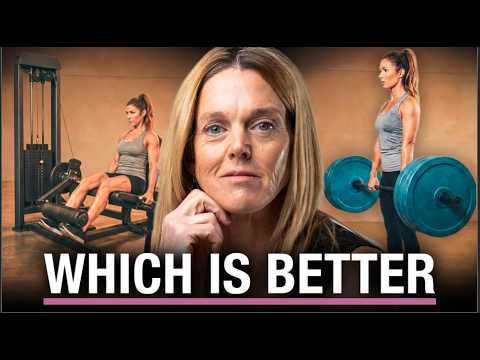
Heavy Lifting for Women Over 40: Why 3-5 Reps Beats 8-12 for Strength, Brain, and Longevity
~11 min
Episode Brief·YouTube

Heavy Lifting for Women Over 40: Why 3-5 Reps Beats 8-12 for Strength, Brain, and Longevity

Stacy Sims
Watch on YouTube Add to chat My bookmarks← All sources

TL;DR

The four things you'd lose by not watching

4 items

TL;DR

The four things you'd lose by not watching

4 items
1

Stacy Sims argues that women over 40 should focus on heavy power-based training (3-5 reps) rather than the traditional 8-12 rep hypertrophy range to combat estrogen-driven power loss and improve longevity.

2

The physiological mechanism: declining estrogen impairs myosin’s ability to bind actin, so low-rep heavy lifting sends a strong CNS signal to force myosin adaptation, preserving muscle quality and power.

3

She introduces French contrast training (heavy set of 3 + explosive movement + set of 6 at 50%) as an advanced method to hit all ends of the force-velocity spectrum and maximize power.

4

Even amenorrheic women with low estrogen should adopt power training, and beginners should start with eccentric tempo work to build strength and confidence before going heavy.

Protocols

Concrete recipes — what, when, how much, and why

2 items

Low-Rep Heavy Power Training (3-5 Reps, RIR 1-2)

WhatPerform compound lifts (squats, deadlifts, presses) with heavy loads that allow 3-5 technically sound reps, leaving 1-2 reps in reserve, emphasizing explosive concentric movement.
When2-3 times per week as the core strength work, especially for perimenopausal, postmenopausal, and amenorrheic women.
Dose3-5 reps per set, RIR 1-2, 3-5 sets depending on exercise and program design.
For whomWomen over 40, perimenopausal and postmenopausal women, and amenorrheic women. Also applicable to any woman with low estrogen.
WhyTo force myosin to adapt and maintain strong contractions despite declining estrogen, preserving power and muscle quality while also building lean mass.
CaveatsRequires mastery of proper technique and a progressive ramp-up. Beginners should first develop movement competency and confidence through tempo work and higher rep ranges before approaching maximal loads.

Stacy Sims emphasizes that power—the ability to produce force quickly—is a premier predictor of healthspan and longevity. When women enter perimenopause, the typical advice is to do hypertrophy work to offset lean mass loss, but this ignores the quality of the muscle. By using loads near the 3-5 rep max, the body receives a clear signal to recruit high-threshold motor units and force myosin to ‘grab on tightly’ to actin. This adaptation maintains explosive strength that prevents the functional decline seen with aging. She notes that the journey to lifting heavy takes time, requiring an understanding of reps in reserve (RIR) and rating of perceived exertion (RPE) to push hard without failure. The protocol is not just about adding weight; it’s about intentional, quality-driven power output that doubles as a bone-density builder.

Mechanism

Estradiol supports myosin’s ability to bind tightly to actin for powerful contractions. As estrogen drops, myosin function diminishes, leading to power loss. Heavy low-rep training provides a strong central nervous system stimulus that forces the neuromuscular system to upregulate myosin’s contractile engagement, compensating for the loss of hormonal support and preserving muscle power.

Personal experience

Stacy describes her own 40% strength loss after minor knee surgery, underscoring how quickly power can vanish and how essential this protocol is for rebuilding and maintaining it.

So this is where we look at the heavier loads and we're looking at the lower rep ranges, so the more the power based end to have a different response in the body to make myosin go, 'Wait a second, I do have to grab on tightly to actin.' And have a very strong, powerful contraction.

Also said
“We want that reps in reserve two or one and we want that.”— Gives the precise effort target for effective power adaptations without overreaching.
“You will get lean mass and strength if you do the power based end of things.”— Reassures that this is not at odds with muscle gain.

French Contrast Training for Advanced Power

WhatA complex set: a heavy set of 3 reps (e.g., back squat), immediately followed by an explosive plyometric (jump squats or box jumps), then a set of 6 reps at 50% of the heavy load. Repeat for 2-3 rounds.
WhenFor women with a solid strength training base who are noticing a decline in power output (e.g., getting up from a chair, climbing stairs feels slower) despite maintaining strength.
Dose2-3 rounds per exercise, with full recovery between rounds; integrate 1-2 times per week in a program.
For whomAdvanced female lifters, perimenopausal and postmenopausal women with training experience, or athletes who need to restore reactivity and power.
WhyTo cover the entire force-velocity spectrum—maximal strength, explosive power, and power endurance—thereby maximizing functional power and rate of force development.
CaveatsExtremely demanding; only appropriate with perfect technique and no existing injuries. Requires careful programming to avoid overtraining and should be periodized.

Stacy introduces French contrast as a high-level solution for women who already have strength but are losing the quick, explosive quality of movement. She describes it as ‘really hard, but so powerful in function.’ The protocol leverages the immediate neural after-effects of a near-maximal contraction to supercharge plyometrics, then uses rapid, submaximal reps to groove speed. This method directly counters the age-related decline in power without sacrificing strength, making it especially potent for women in menopause who want to maintain athleticism and daily function. It’s not an everyday protocol but a strategic tool for those ready to push beyond conventional heavy lifting.

Mechanism

The heavy set uses post-activation potentiation to prime the nervous system, making the subsequent explosive movement more powerful. The lighter set at 50% maintains high bar speed and reinforces the neuromuscular pathway at speed, training the ability to produce force rapidly across a range of loads.

So, the idea of lifting really heavy, like a three rep kind of three rep sets right into an explosive movement into maybe six reps. So, we're looking at, okay, if we're doing squats to improve power and function there, we're doing a heavy set of three, maybe we're doing two or three sets of this heavy set of three right into some jump squats or maybe some box jumps or something like that, where you have that explosive power right off the end, right into a set of six at 50%.

Also said
“It's really hard, so that's more advanced, but it's so powerful in function.”— Emphasizes the difficulty and effectiveness.

What's new

Personal practice updates, fresh positions, predictions

3 items

power-based-training-for-perimenopause

early in the conversation

Stacy Sims asserts that as estrogen starts to fluctuate and decline in perimenopause, women should prioritize low-rep (3-5) heavy lifting over the classic 8-12 rep hypertrophy range to specifically target myosin function and prevent power loss.

Why this matters: This upends the common advice that women losing lean mass need hypertrophy training alone. She points to new data showing that rep ranges are not strict, and power training also builds muscle while simultaneously addressing the overlooked issue of declining power—a key predictor of healthspan.

Background

Historically, women were steered toward light ‘toning’ weights out of fear of getting bulky, and even medical advice for osteopenia/osteoporosis focused on drugs like Fosamax without prescribing strength training. This left a gap in maintaining bone and muscle quality as women aged.

Sims explains that myosin, one of the contractile proteins in muscle, is driven by estradiol. When estrogen declines, myosin’s ability to grab onto actin and produce a strong contraction weakens, causing a loss of power. The typical 8-12 rep range creates a metabolic cost and can build some lean mass, but it doesn’t provide the strong central nervous system stimulus needed to force myosin to adapt. In contrast, heavier loads in the 3-5 rep range with 1-2 reps in reserve send a potent signal that says ‘you have to grab on tightly’ to actin, preserving muscle power. She references Brad Schoenfeld’s recent work debunking strict rep ranges for hypertrophy, supporting the idea that low-rep training can also build lean mass, tackling both muscle quantity and quality in one go. This shift is critical for women navigating perimenopause and beyond, as it directly protects the power output that predicts how well we’ll live as we age.

Personal experience

Stacy shares: ‘I’m 5 weeks post surgery and I've lost 40% of my strength in 5 weeks… It takes a lot to build muscle. Takes a lot.’ She has family members who were prescribed Fosamax without any recommendation for strength training, which fueled her frustration with the lack of exercise-based interventions.

If you stay in that eight to 12 rep range which everyone thinks about hypertrophy, it's more of a metabolic cost. ... you're not addressing the full power loss issue there cuz you're not instigating more of a central nervous system response to make myosin step up.

Also said
“This is where we look at the heavier loads and we're looking at the lower rep ranges, so the more the power based end to have a different response in the body to make myosin go, 'Wait a second, I do have to grab on tightly to actin.' And have a very strong, powerful contraction.”— Explains the mechanism in vivid, conversational terms.
“You will get lean mass and strength if you do the power based end of things. So you're taking care of two birds with one stone.”— Directly counters the fear that heavy low-rep training won’t build muscle.

power-training-for-amenorrheic-women

mid conversation

Stacy Sims extends the low-estrogen power training recommendation to reproductive-age women with hypothalamic amenorrhea or other causes of estrogen loss, stating they too should lift heavy for power.

Why this matters: Most advice for amenorrhea emphasizes reducing exercise volume or addressing energy availability; adding heavy power training as a deliberate physiological adaptation strategy is a novel, hormone-responsive approach.

Background

Amenorrheic women often stop heavy training out of concern for bone health or hormonal recovery, but Sims points out that the low estrogen state mirrors menopause, making myosin dysfunction a relevant target.

Sims connects the hormonal profile of amenorrhea to the same myosin impairment seen in perimenopause. By advocating power training across these two populations, she reinforces that the loss of estrogen—not age—is the primary driver of muscle quality decline. This suggests that the heavy, low-rep protocol is a universal intervention for low-estrogen states, not just a menopause strategy.

Even women who are amenorrheic, who are in their reproductive years and have hypothalamic amenorrhea or some other loss of estrogen, they too should be looking after the power based end of things.

brad-schoenfeld-rep-ranges-hypertrophy

mid conversation

Stacy Sims highlights emerging research from Brad Schoenfeld that the old idea of strict rep ranges for hypertrophy is outdated, supporting her view that low-rep power training builds muscle while addressing power loss.

Why this matters: This validates her protocol with the latest exercise science and removes a common objection—that women must use moderate reps to build lean mass.

Background

The fitness industry long taught that 1-5 reps build strength, 8-12 build hypertrophy, and 15+ build endurance. The new understanding is that muscle growth can occur across rep ranges when sets are taken near failure.

Sims uses this research to dismantle the ‘hypertrophy vs. strength’ dichotomy. She has been advocating that power training is both strength and muscle-building, and the Schoenfeld data gives her argument backing. This means women can confidently pursue low-rep heavy lifting without worrying they’re missing out on muscle gains, making the protocol more accessible and evidence-based.

Personal experience

She says, ‘Yes, I've been saying that’ in reaction to the new findings, indicating she’s been ahead of the curve.

Now with Brad Schoenfeld's new thing that's been circulating saying there that that's the old idea of having these rep ranges for hypertrophy, it's like, 'Yes, I've been saying that.'

Recommendations

Products, supplements, and tools mentioned in the episode

1 item

Strength Training as First-Line Intervention Instead of Osteoporosis Drugs

Practice

Stacy Sims criticizes the historical medical approach of prescribing Fosamax for osteopenia/osteoporosis without recommending strength training, and advocates that heavy resistance training should be the foundational treatment for bone health and overall function.

She recalls family members who were told to take Fosamax and were given no exercise guidance. When doctors did mention strength training, women resisted because of the ‘bulky’ myth. Sims argues that strength training not only builds muscle but directly pulls on bone to increase density, offering a solution that addresses the root cause of fragility rather than just a pharmaceutical patch. Her stance is that strength training should be promoted as the be-all end-all for many chronic conditions, especially for aging women.

vs alternatives

Versus Fosamax: strength training produces no systemic side effects, improves metabolic health, reduces falls risk, and enhances quality of life, while Fosamax only slows bone loss and can have side effects like GI issues and rare fractures. Strength training is a holistic, sustainable intervention.

Personal experience

'I think about like some of my relatives who were also like, you need to get on Fosamax, and they're like, “What? I don't want to go on that.” … And so it's like, well, what what recommendations do they have to kind of take care of that? There weren't any.'

It also supports your skeletal system. It pulls on the skeletal system to increase your bone density. Like, there's so many positive things about strength training and having muscle, especially as we get older.

Also said
“Why are we not pushing strength training as the be-all end-all for almost every disease that's out there? It should be like the baseline for everything to improve population health.”— Reinforces the recommendation as a public health imperative.
Find Strength

Notable quotes

Lines worth pulling out — contrarian, specific, or perfectly phrased

5 items
It takes a lot to build muscle. Takes a lot.
A blunt, memorable reality check that counteracts the myth that women will accidentally get bulky.
Why are we not pushing strength training as the be-all end-all for almost every disease that's out there? It should be like the baseline for everything to improve population health.
A powerful rhetorical question that frames strength training as a universal public health intervention.
If we lose our power, then we have an indication that we're losing our muscle or our muscle quality.
Frames power loss as a critical biomarker for aging, shifting the conversation from just muscle mass to function.
You will get lean mass and strength if you do the power based end of things. So you're taking care of two birds with one stone.
A concise, actionable summary that rebuts the hypertrophy myth and simplifies the training message.
Even women who are amenorrheic, who are in their reproductive years and have hypothalamic amenorrhea or some other loss of estrogen, they too should be looking after the power based end of things.
An unexpected extension of the protocol to another low-estrogen population, showing the hormonal principle is universal.

Sign in to share feedback

Tell us if this brief hit the mark or missed it — feedback feeds back into the next iteration of the prompt.

Topics covered

strength-trainingwomen-over-40power-trainingestrogenmyosinsarcopeniaosteoporosisFosamaxhypertrophyreps-in-reserveamenorrheaFrench-contrasttempo-trainingbody-compositionbone-densitymuscle-qualityrating-of-perceived-exertionBrad-Schoenfeld
Free account

Make this library yours

Reading is free for everyone. A free account adds the personal layer: save protocols, follow experts, and see how the other experts weigh in on this same topic.

Create a free accountSign in

Where the experts disagree — weekly

One email a week: the sharpest new disagreements and protocols from the library. No spam, unsubscribe anytime.

Educational summary of the cited expert source — not medical advice. Open the source recording linked above and consult a qualified physician before acting on any protocol.