UNFUCG
DashboardSearchChatBookmarksNotificationsActivityPremiumProfile
?
Home
Search
Chat
Saved
Profile
Episode
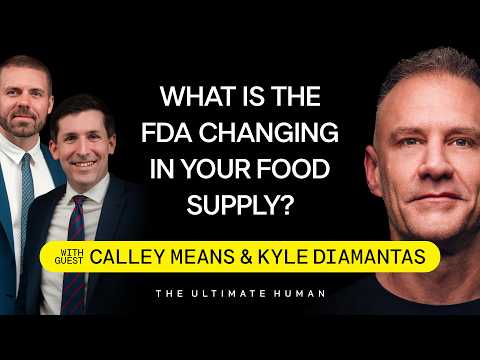
Calley Means & Kyle Diamantas: On MAHA, Food Dye Reform, GRAS Loopholes & US Food Crisis | TUH #260
~79 min
Episode Brief·YouTube

Calley Means & Kyle Diamantas: On MAHA, Food Dye Reform, GRAS Loopholes & US Food Crisis | TUH #260

Gary Brecka
Watch on YouTube Add to chat My bookmarks← All sources

TL;DR

The four things you'd lose by not watching

4 items

TL;DR

The four things you'd lose by not watching

4 items
1

FDA launched a systematic post-market review of food chemicals, ending decades of reactive-only oversight after the GRAS loophole allowed over 90% of new additives to skip safety review.

2

HHS and FDA secured voluntary hospital commitments to serve food meeting dietary guidelines, backed by CMS conditions of participation, starting with Florida’s Nicklaus Children’s Hospital.

3

For the first time since 1998, FDA undertakes a comprehensive review of infant formula nutrient standards and contaminant testing under Operation Stork, with 13 new foreign formulas approved for the U.S. market.

4

The MAHA agenda achieved removal of artificial dyes from kids’ food, soda and candy from SNAP in many states, and a foundational shift in dietary guidelines to prioritize whole foods over ultra-processed.

Protocols

Concrete recipes — what, when, how much, and why

3 items

choose-whole-foods-over-ultra-processed

WhatReplace ultra-processed foods with whole, minimally processed items by reading ingredient labels and avoiding products with long lists of unpronounceable additives.
WhenEveryday grocery shopping and meal preparation.
For whomAll consumers, especially parents.
WhyConsumer spending drives corporate behavior; individual choices create market demand for healthier options and reduce intake of compounds linked to chronic disease.
CaveatsAcknowledges that food deserts and affordability are a challenge, but cooking at home can be cost-effective.

Cali Means emphasized that while the government has not had consumers' backs due to incentivizing ultra-processed foods, the awakening must happen from the bottom up. He urged listeners to be conscious of what they eat, read food labels, and try to eat minimally processed food. He noted that cooking at home can be very affordable and that collectively these choices will change the food system. Kyle added that consumers have more power than regulators, as companies are responsive to wallets. Multiple examples were given: flight attendants noticing a shift to sparkling water away from soda, and supermarkets reporting increased sales of beans, whole protein, and produce. The protocol is about personal responsibility aligning with the MAHA movement's goal to reshape the food environment.

Mechanism

By avoiding ultra-processed ingredients, consumers reduce intake of sugar, seed oils, and chemical additives that fuel inflammation and insulin resistance, key drivers of chronic disease.

The most revolutionary thing everyone can do is really be conscious of what they're eating. Read your food labels. Try to eat minimally processed food.

Also said
“consumers make their voices heard with their wallet.”— Reinforces that purchasing power drives corporate reform.

call-legislators-on-maha-bills

WhatWhen you hear about bills addressing food dyes in schools, SNAP waivers, cell phones in schools, or GRAS reform, call your state and federal representatives to voice support.
WhenWhenever such legislation is under consideration.
For whomAny constituent, particularly parents and community activists.
Why100 calls on an issue make a huge difference; 30 states have already passed MAHA bills because of grassroots calls.

Cali stressed that most people don't call, so even a small volume of calls can tip legislative outcomes. He cited 30 states that have passed MAHA bills on topics like cell phones in schools, school lunches, and food dyes, all driven by 'MAHA moms' calling local legislators. Kyle reinforced that engagement in the public process—whether calls, letters, or comments—has tangible impact. The underlying message is that while regulatory change takes time, direct citizen pressure on elected officials accelerates the movement and makes policies durable.

100 calls on an issue actually make a huge difference. Most people don't pick up the calls.

Also said
“We have had 30 states do Maha bills on getting cell phones out of schools, improving school lunches, getting food dyes out of schools, SNAP waivers on the soda. This is all happening because Maha moms, Maha supporters called their local legislators for these bipartisan bills.”— Provides concrete success stories that validate the protocol.

submit-public-comments-to-fda

WhatWhen FDA opens a docket for public comment on regulations like nutrition labeling, GRAS reform, or infant formula standards, submit your views in writing.
WhenDuring public comment periods announced by FDA.
For whomCitizens, especially parents and health advocates.
WhyPublic comments become part of the official record and influence rule-making; being vocal matters.

submitting comments to FDA, being vocal, all of those things matter.

What's new

Personal practice updates, fresh positions, predictions

4 items

fda-proactive-post-market-review

mid-discussion on FDA pillars

FDA created a systematic framework to reevaluate food chemicals already on the market, moving from reactive responses to proactive, science-based reassessments.

Why this matters: Historically, once an ingredient was in the food supply, it stayed without systematic re-evaluation. This new office is a legacy item under this administration.

Background

Previously, FDA was reactive, only investigating after outbreaks, petitions, or adverse events. There was no mechanism to continuously review safety of chemicals introduced decades ago.

Kyle Diamantas, head of human foods at FDA, explained that the agency's food chemical safety work now includes a new post-market office. For decades, FDA's approach was reactive: it acted only when prompted by a citizens' petition, an outbreak, adverse event reports, or congressional inquiry. Once an additive was in the food supply, it effectively stayed there. That system failed to keep up with evolving science and mounting evidence of harm. Under Secretary Kennedy and President Trump, FDA has stood up a robust framework for systematic post-market review. The process is designed to be science-based, transparent, and formalized through rule-making and public comment, so future reviews are part of a durable regulatory structure. Kyle noted that this move has the potential to become a lasting institutional change, ensuring that ingredients approved 30–50 years ago are not exempt from modern safety scrutiny. This shift is a cornerstone of the MAHA initiative to prevent chronic disease by fixing the original safety oversight gap.

We never had a systematic process for post-market review. We were really only looking at things if there was a citizen's petition, outbreak, a number of adverse event reports, congressional inquiries, then we might look at an ingredient that's already in in supply.

Also said
“traditionally, it's been that once it was in, it was sort of in, and there was not a process for FDA to really systematically reevaluate those things.”— Emphasizes the systemic gap that the new framework is designed to close.

hospital-food-reform

midway, ahead of hospital announcement

CMS will issue conditions of participation requiring hospitals that receive Medicare/Medicaid funding to serve food meeting dietary guidelines, starting with a voluntary pledge in Florida.

Why this matters: For the first time, the federal government is using its financial leverage to stop hospitals from serving sugary drinks, fried food, and ultra-processed items to patients.

Background

Hospitals commonly serve sugary sodas, gelatin with dyes, and refined carbohydrates to patients, including diabetics and cancer patients, while billing CMS up to $400 per day for food.

The segment was sparked by Gary Brecka's personal story of a friend with colon cancer being served Jell-O with red dye and a sugary ginger ale at Mayo Clinic, leading to a viral post by his wife. Cali Means explained that HHS asked why the government pays hospitals over a trillion dollars while they serve food that fuels the chronic diseases accounting for 90% of that spending. The solution: CMS can issue letters and conditions of participation linking payments to nutritional standards. On the day of recording, Florida hospitals were making voluntary commitments, spearheaded by Nicklaus Children's Hospital, to serve food aligned with the dietary guidelines—emphasizing fresh produce, whole proteins, whole grains, and reducing sugars and ultra-processed foods. Kyle noted that hospital CEOs welcomed the nudge, acknowledging the contradiction. Cali framed this as a public-private partnership flywheel: regulation nudges, voluntary commitments follow, and the market shifts, benefiting not just patients but the millions of Americans who eat in hospital cafeterias daily.

Personal experience

Gary Brecka shared: 'I remember we were sitting in the ICU... they brought in the tray of food and it was pureed applesauce, Jell-O, which actually still had the red dye, and a Seagram's Ginger Ale. 52g of sugar, no protein, no fats, like no nutrition.'

It is absolutely disgraceful what hospitals are serving patients.

Also said
“We have asked a simple question to hospitals, which is why is the government paying you trillions of dollars to serve food that is fueling the chronic diseases that 90% of those payments are going to?”— States the core financial argument driving the policy change.

infant-formula-nutrient-review

later segment on infant formula

FDA is undertaking the first comprehensive review of mandatory nutrient levels in infant formula since 1998, alongside testing for PFAS, heavy metals, and other contaminants.

Why this matters: The last time nutrient standards were reviewed, no changes were made; this is a generational update with world-class expert input and foreign collaboration.

Background

Infant formula is sole source nutrition for many infants. Currently 30 mandatory nutrients, only 10 have maximum limits. FDA inspects formula facilities annually and has a dedicated investigator cadre.

Kyle Diamantas detailed Operation Stork, noting that infant formula is regulated closer to a drug than a food due to its critical role. The last comprehensive nutrient assessment occurred in 1998 but resulted in no changes, meaning standards are decades behind nutrition science. This year, FDA issued a request for information, receiving input from researchers, parents, industry, and foreign regulators. The goal is to modernize nutrient requirements through formal rule-making. Simultaneously, FDA conducted extensive testing for contaminants like PFAS, phthalates, heavy metals, and pesticides. Kyle reported that early results show low levels, comparable to or better than EPA water standards. He emphasized that the U.S. infant formula supply is in good shape contamination-wise, but the process will tighten microbiological safety in light of past Cronobacter outbreaks. To stabilize the market post-2022 shortage, FDA allowed 13 foreign formulas from Europe, Australia, and New Zealand to be legally sold in the U.S., with FDA inspectors on-site overseas ensuring same standards. This dual push of nutrient update and contaminant transparency is framed as a major win for parents.

We are undertaking for the first time since 1998... to comprehensively assess and review the nutrient requirements in infant formula.

Also said
“we've also engaged in comprehensive testing to look at things like PFAS, phthalates, any number of heavy metals, pesticides. And we're going to be releasing data on that in the near term.”— Shows the transparency and proactive contaminant monitoring component.

media-political-resistance-to-maha

near end, reflection on surprises

Cali Means discovered that media and entrenched bureaucrats prioritize destroying Trump and Kennedy over advancing child health policies.

Why this matters: Despite the bipartisan nature of chronic disease issues, Democrats and media refuse to engage, with some journalists admitting the goal is to deny them wins.

Background

Cali's book and early advocacy were nonpartisan, embraced by Nancy Pelosi and progressive Democrats, but the alliance with Trump caused a media and political backlash.

When asked what surprised him most, Cali described a toxic culture in Washington. His book and early advocacy were nonpartisan, embraced by Nancy Pelosi and progressive Democrats, but once Trump and Kennedy championed the issues, the media flipped. Articles focus exclusively on vaccines or raw milk, ignoring chronic disease work. He recounted a leading reporter telling him that the culture in the media is that destroying President Trump and Bobby Kennedy is more important than children's health. He also pointed to career bureaucrats who see themselves as protecting science against the administration. This division extends to Democrats who previously supported his work but now refuse to respond. Cali expressed frustration that these no-brainer 95% issues get zero bipartisan cooperation. He contrasted this with genuine floor-level wins achieved despite the headwinds.

Personal experience

Cali shared his experience: 'I have reached out to Democratic staff and Democratic senators, and they have not received one response. The people that were passing around my book very passionate about these issues and friends with Bobby Kennedy in the past, they do not respond to us.'

a leading reporter told me this that the culture in the media is that they want to destroy President Trump and Bobby Kennedy and that goal is more important than children's health.

Also said
“the media has an absolute immune response to look at anything good and find the problem.”— Describes the reflexive negative framing that marginalizes the chronic disease work.

Recommendations

Products, supplements, and tools mentioned in the episode

2 items

Watch the Tucker Carlson interview with Casey and Cali Means

Practice

Gary Brecka recommends it as the best podcast he's seen, laying the foundation for understanding corruption in food supply and nutritional research.

The host recounts that his wife told him about the Tucker Carlson interview featuring Casey and Cali Means. After watching it, he became convinced of the intentionality behind the food system's corruption. He now strongly recommends that listeners watch it to grasp the depth of the problem and the origins of the MAHA movement. The interview reportedly covers the systemic issues that led to Cali and Casey writing their book and eventually entering government service.

Personal experience

Gary Brecka: 'my wife comes into the kitchen one day and she's like, "Babe, have you seen this Tucker Carlson interview with Casey and Kelly Means?" And I was like, "No, who's Casey Who are Casey and Kelly Means?" And she was like, "It's literally the best podcast I've ever seen."'

If you haven't seen that Tucker Carlson interview, it really laid the foundation for the level of corruption in our food supply and our nutritional research.

Find Watch

Cook meals at home with fresh whole ingredients

Practice

Cali Means advises that cooking at home can be very affordable and is a powerful way to take control of your food quality, aligning with the MAHA movement.

In the context of urging personal responsibility, Cali highlighted that while government incentives have made ultra-processed food cheap and abundant, households can reclaim their health by preparing meals from scratch. He noted that content is being created to show how low-cost home cooking can replace processed options. This practice directly cuts out the additives and excessive sugars prevalent in packaged and restaurant foods, and it signals to the market a demand for whole ingredients.

I know it's tough for people out there. We're trying to put content out there about how cooking at home, you know, is can actually be very affordable.

Find Cook

Notable quotes

Lines worth pulling out — contrarian, specific, or perfectly phrased

6 items
It is absolutely disgraceful what hospitals are serving patients.
A stark, succinct condemnation that anchors the hospital food reform initiative.
over 90% of new ingredients in the food supply, which we can't pronounce, which are totally novel compounds, are designated by industry as generally recognized as safe, which then means that the FDA does not have a record of that ingredient being added in the food supply, and has no record of safety studies whatsoever.
Quantifies the scale of the GRAS loophole problem in a single, memorable sentence.
The most revolutionary thing everyone can do is really be conscious of what they're eating. Read your food labels. Try to eat minimally processed food.
Concise call to personal action that sums up the bottom-up strategy of the MAHA movement.
100 calls on an issue actually make a huge difference. Most people don't pick up the calls.
Dispels the 'my voice doesn't matter' myth with a concrete, actionable metric.
a leading reporter told me this that the culture in the media is that they want to destroy President Trump and Bobby Kennedy and that goal is more important than children's health.
Reveals a behind-the-scenes admission of media bias that prioritizes political destruction over public health.
The food leads to the drugs.
Powerful, distilled logic linking diet to pharmaceutical dependency and chronic disease.

Sign in to share feedback

Tell us if this brief hit the mark or missed it — feedback feeds back into the next iteration of the prompt.

Topics covered

gras-loopholehospital-foodinfant-formulafood-dye-reformsnap-reformmaha-movementfda-post-market-reviewcorporate-cooperationmedia-biaspolitical-polarizationpersonal-responsibilityultra-processed-foodchronic-diseasedietary-guidelinesfda-regulation
Free account

Make this library yours

Reading is free for everyone. A free account adds the personal layer: save protocols, follow experts, and see how the other experts weigh in on this same topic.

Create a free accountSign in

Where the experts disagree — weekly

One email a week: the sharpest new disagreements and protocols from the library. No spam, unsubscribe anytime.

Educational summary of the cited expert source — not medical advice. Open the source recording linked above and consult a qualified physician before acting on any protocol.