
UNFUCG
DashboardSearchChatBookmarksNotificationsActivityPremiumProfile
?
Home
Search
Chat
Saved
Profile
Episode
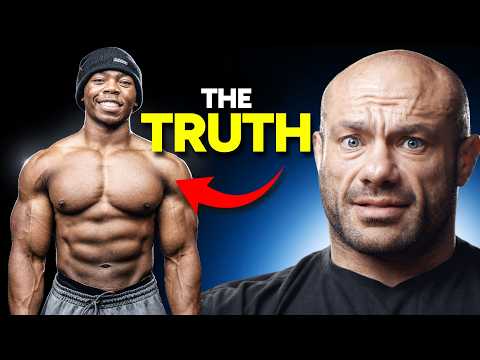
Exercise Scientist Critiques the Most Jacked 19-Year-Old : Natty or Enhanced?
~26 min
Episode Brief·YouTube

Exercise Scientist Critiques the Most Jacked 19-Year-Old : Natty or Enhanced?

Mike Israetel
Watch on YouTube Add to chat My bookmarks← All sources

TL;DR

The four things you'd lose by not watching

4 items

TL;DR

The four things you'd lose by not watching

4 items
1

Mike Israetel assesses 19-year-old Julian Fitzgerald as likely natural, citing extreme genetic outliers (1 in 10,000) and West African ancestry, giving a 40–60% chance of drug use but ultimately believing he's drug-free.

2

He provides a detailed shoulder hypertrophy protocol: 2–4 sessions per week, 1–2 exercises each, 5–7 sets per workout, ~15 reps per set, emphasizing lateral raises, face pulls, and upright rows; Myo Rep Match can be added.

3

He endorses Hany Rambod's rowing technique of intentional rounding and arching for back thickness, explaining that rows are poor lat builders due to limited stretch, and recommends isolation work like lat prayers and flies for back/chest when arms dominate.

4

He promotes his own products: RP Hypertrophy App, Hyper Belt (designed with Jared Feather), and recommends Versa Grips for grip security during pulls.

Protocols

Concrete recipes — what, when, how much, and why

5 items

Shoulder Hypertrophy Protocol

WhatTrain shoulders 2–4 times per week with 1–2 exercises per session, focusing on lateral raises, face pulls, and upright rows. Perform 5–7 sets per workout, averaging ~15 reps per set. Optionally use Myo Rep Match for added volume.
WhenThroughout the training week, integrated into upper body or dedicated shoulder days.
Dose2–4 sessions/week, 1–2 exercises, 5–7 sets each, ~15 reps.
For whomAnyone wanting bigger shoulders, especially those whose arms overpower their delts.
WhySide delts are primarily responsible for the wide-shouldered look; front delts get work from chest pressing, rear delts from back work. High volume and frequency are needed for maximal hypertrophy.
CaveatsAvoid overreaching; use an app or careful programming to manage volume. Shoulder pressing is less effective for side delts.

Mike explains that many people mistakenly rely on overhead pressing for shoulder size, but pressing mainly hits front delts and triceps. The visual pop comes from side delts, which respond best to isolation exercises like lateral raises. He recommends a high frequency (2–4x/week) with moderate per-session volume (5–7 sets) to accumulate sufficient weekly volume without excessive fatigue. He suggests an average of 15 reps per set, which balances mechanical tension and metabolic stress. He also mentions Myo Rep Match as an advanced technique to increase effective volume. He emphasizes that this approach is simple but requires consistency and volume.

Mechanism

Side delts are relatively small muscles that recover quickly and benefit from frequent stimulation. High reps with moderate loads create metabolic stress and pump, which may contribute to hypertrophy. The front delts are already heavily stimulated by pressing movements, so additional isolation is often unnecessary.

Two to four sessions a week of shoulders, one to two exercises each time. It's not that many, but a boatload of sets and reps. With average of about 15 reps per set, but maybe five to seven sets per workout.

Also said
“To get the biggest shoulders you can visually, remember almost all of your chest work involves the front delts. Almost all of your back work involves and really taxes the rear delts. And the pop look from the side is really just about side delts.”— Clarifies why isolation for side delts is the priority.
“So, you can do a crap load of face pulls, upright rows of various kinds, and machine or cable or dumbbell laterals till you're blue in the face.”— Lists the specific exercises to use.

Back and Chest Isolation for Arm-Dominant Lifters

WhatWhen arms are disproportionately large and take over compound movements, use mind-muscle connection to focus on the target muscle, and incorporate isolation exercises like lat prayers (for back) and flies (for chest) that minimize arm involvement.
WhenDuring back and chest training sessions, especially if you notice arms fatiguing before the target muscle.
DoseInclude at least one isolation movement per session; practice mind-muscle connection on every rep.
For whomLifters with genetically large arms that overshadow chest/back development.
WhyDominant muscles can limit growth of weaker muscles by taking on more load; isolation exercises force the target muscle to work harder.
CaveatsMind-muscle connection is difficult for beginners; isolation exercises may require lighter weights initially. Don't abandon compounds entirely—they still stimulate growth.

Mike explains that when a muscle is disproportionately strong, it tends to take over multi-joint movements, reducing stimulus to the intended muscle. For back, the biceps and forearms can dominate rows and pulldowns; for chest, the triceps and front delts can dominate pressing. He offers two solutions: first, consciously focus on feeling the target muscle work (mind-muscle connection), which improves with practice. Second, include exercises that almost exclusively target the back or chest with minimal arm contribution, such as lat prayers (straight-arm pulldowns) and various flye variations. He notes that while compounds still work, adding isolation ensures the target muscle gets sufficient direct stimulus. He also mentions that this approach takes time to master but is effective.

Mechanism

Isolation exercises reduce the mechanical advantage of the arms, forcing the target muscle to generate most of the force. Mind-muscle connection may enhance neural drive to the target muscle, improving activation and potentially hypertrophy.

Personal experience

Mike says, 'Some people that I have worked with in the past had really big arms and when they were doing back, they would pull with their arms and therefore wouldn't stimulate their back enough to grow.' This is based on his coaching observations.

How do you remediate this? There are at least two ways to do this. One is you try to make sure that when you are using, for example, let's say you have big ass arms and they take over on back stuff or big ass triceps and they take over on chest stuff, have a mind muscle connection that you continue to emphasize kinesthetic awareness that you're pulling with your back.

Also said
“Another one is to make sure that movements you are doing in many cases are either very emphasizing of the back and not of the arms or exclusively back. For example, if you're doing lat prayers, really that's just like your back has to be the limiting factor on that.”— Gives a concrete example of an isolation exercise for back.
“For chest, flies. Flies are going to jack up your chest one way or the other. So, if you do a crap load of flies anywhere in your program, then it's going to be a big benefit.”— Provides the equivalent isolation strategy for chest.

Rowing with Intentional Rounding and Arching

WhatWhen rowing for back thickness, allow the spine to round slightly on the stretch and then arch on the contraction, as demonstrated by Hany Rambod's cues. This engages the spinal erectors, rhomboids, and traps more effectively.
WhenDuring any rowing exercise aimed at back thickness (e.g., barbell rows, cable rows).
DoseApply on every rep; control the eccentric and use a full range of motion with dynamic spinal movement.
For whomAnyone seeking a thicker back, especially those who already have good lat development from vertical pulling.
WhyRows are not optimal for lats because they don't stretch the lats sufficiently; they primarily thicken the back by working the erectors and mid-back muscles. Rounding and arching maximizes the stretch and contraction of these muscles.
CaveatsEnsure you maintain control and don't use excessive momentum; this technique is for hypertrophy, not powerlifting. Beginners should learn proper bracing first.

Mike argues that rows are often mischaracterized as lat exercises, but the lats are best trained with overhead movements that allow a deep stretch (pull-ups, pulldowns, pullovers). Rows, by contrast, keep the lats in a shortened position and primarily hit the spinal erectors, rhomboids, and traps. He praises Hany Rambod's cue to round the back on the eccentric to stretch these muscles, then arch hard on the concentric to contract them. This dynamic movement increases the range of motion and tension on the target muscles. He contrasts this with the common advice to keep a perfectly straight back, which he believes limits the effectiveness for back thickness. He emphasizes that this technique is specifically for hypertrophy and should be done with controlled reps.

Mechanism

The spinal erectors and rhomboids are stretched when the spine flexes (rounds) and contracted when it extends (arches). This full range of motion under load likely maximizes mechanical tension and stretch-mediated hypertrophy. The lats, however, are not significantly stretched in rows because the shoulder is not overhead; thus, rows are poor lat builders.

Personal experience

Mike expresses frustration with common rowing advice: 'One of my absolute pet peeves... is when people analyze row technique and they're like, Well, you should can just isolate, stay completely straight, just do this cuz it's for the lats.'

Hany's cues here of rounding on purpose and then arching on purpose are absolutely awesome for rows. It's how you should be rowing.

Also said
“Rows are not the best lat exercise. Why? Because they don't even let the lat come anywhere close to its halfway point of stretching and we know damn near for a fact at this point that the lengthened component of the exercise probably causes disproportion amount of growth, which means the really effective lat exercises are overhead work like pull downs, assisted pull ups, pull ups of every kind and all kinds of straight arm work like dumbbell stuff, cable stuff, lat pulls of every kind, pull overs, etc. etc. etc.”— Explains the biomechanical rationale for why rows aren't for lats.
“Rows are an excellent back thickening exercise. They absolutely do stimulate lats as well, but they stimulate the spinal erectors a ton. They stimulate the rhomboids, the lower and and middle traps and all those muscles that actually make you thicker.”— Clarifies what rows actually target.

Close Grip Bench Press for Arm-Dominant Lifters

WhatIf your arms are a strong point relative to your chest, use a closer grip on bench press to better leverage arm strength and potentially lift more weight.
WhenDuring chest training, as an alternative to standard grip.
For whomLifters with disproportionately large arms and a relatively weaker chest.
WhyA closer grip shifts emphasis to the triceps and front delts, which may be stronger in individuals with large arms, allowing greater overload.
CaveatsMay reduce chest activation; use in conjunction with isolation work for chest.
Personal experience

Mike says, 'I knew a a couple of super jacked black dudes with crazy big ass arms and like very good, but not amazing chests that did their best bench pressing with a closer grip. Makes sense.'

Interestingly enough, pressing with a very close grip, it might be that he is strongest with that closer grip because his chest is good, but his arms are amazing and this uh closer grip actually favors that arrangement.

Never Stop Training Arms

WhatDo not reduce or eliminate arm training to bring up other body parts; continue training arms with normal volume and intensity.
WhenThroughout all training phases, even when trying to improve shoulders or back.
For whomAnyone with well-developed arms who is tempted to cut back on arm work.
WhyBig arms are a key aesthetic feature and reducing their training may cause them to shrink without significantly boosting other muscles.
CaveatsEnsure overall program balance; don't neglect other muscle groups.

Mike references the Phil Heath example and states his strong opinion against deemphasizing arms. He believes that arms should always be trained because they contribute massively to the overall look of muscularity. He also notes that systemic fatigue from arm training is minimal, so it doesn't interfere with other training.

Personal experience

Mike says, 'I do not like deemphasizing arms.' and 'Bigger arms are never the wrong answer.'

Do not deemphasize your arms. Keep growing them. Bigger arms are never the wrong answer.

What's new

Personal practice updates, fresh positions, predictions

2 items

julian-fitzgerald-likely-natural

Mike argues that Julian is probably not on steroids, despite his extreme muscularity at 19, due to rare genetic outliers and his West African heritage.

Why this matters: Contrarian to many online accusations; provides a nuanced probability assessment and highlights underappreciated genetic diversity.

Background

Many viewers assume any extremely muscular teenager must be using performance-enhancing drugs, especially with arms as large as Julian's.

Mike begins by acknowledging that there is always a probability someone is on drugs, but he doesn't think it's the first conclusion to jump to. He estimates a 40–60% chance of drug use based on population base rates, but then lays out two reasons the assumption often fails. First, human genetic variation is far wider than most people realize: while some individuals will never exceed 14-inch arms despite optimal training, others—roughly one in 10,000—can naturally achieve 20-inch arms within a few years. Second, he points to the factor of West African descent (being Black), noting that African Americans have a disproportionately high genetic potential for muscularity without drugs. He contrasts European perspectives, where such physiques are rarely seen, with the reality in the United States. He also factors in Julian's claimed natural status, his demeanor as a devout Christian, and Mike's own experience assessing skin quality and textural features that often betray steroid use. He concludes that, in his opinion, it is very likely Julian is natural, and contrasts him with Larry Wheels—a Black man with a known steroid history who dwarfs Julian—to illustrate the difference.

Personal experience

Mike references his travels in Europe and his familiarity with skin quality indicators, implying he has seen enough drug-free and enhanced physiques to make an informed judgment.

I would say him being on drugs, knowing nothing about him, not to disparage his good name is roughly even chance. 40 to 60%.

Also said
“Number one, human genetic variation is much wider than most people comprehend. There are people out there that will train for years in the most scientific way and their arms will never get bigger than 14 in. There are other people on the other side of the normal curve, three or four standard deviations out, which means they're one in every 10,000-ish, that will within several years of training just have 20-in arms with no steroids at all, just raw genetics.”— Quantifies the rarity of extreme natural potential.
“And the second thing I have to say about that is there is one extra factor. It's called being of West African descent. In in America, we just call that black. ... they are a very talented peoples. And their ability to be gigantic for no good goddamn reason at all is out there.”— Introduces the ethnic/genetic component that many overlook.
“And I would bet, knowing both that he is a devout Christian, mad respect, and he seems like a really nice guy, and he's only 19 years old, and he pronounces to be lifetime drug free on his socials, and also I've been around and I know what skin quality looks like and various other textural features, I'm going to say that it's actually very likely in my opinion he is actually not on drugs.”— Synthesizes his final judgment based on multiple soft indicators.

disagreement-with-hany-rambod-arm-cessation

Mike disagrees with legendary coach Hany Rambod's tactic of stopping arm training for Phil Heath until 3 weeks before a show, arguing that arms should be trained throughout prep to maintain size and that systemic fatigue wouldn't have been an issue.

Why this matters: Challenges a widely respected coach's method; offers an alternative perspective on managing dominant body parts.

Background

Hany Rambod, known for coaching Phil Heath to multiple Mr. Olympia titles, reportedly had Phil stop training arms to focus on shoulders, then reintroduced arm training late in prep.

Mike acknowledges Hany Rambod's greatness but believes Phil's arms were a key asset and that ceasing arm training risked losing size. He argues that systemic fatigue from arm training is minimal, so Phil could have continued training arms normally while adding more delt work. He thinks this would have made a significant positive difference in Phil's physique. He emphasizes that big arms are never a liability and that reducing arm training is unnecessary. He also points to Phil's most muscular pose as evidence that his triceps were a standout feature worth preserving.

Personal experience

Mike states his own opinion directly: 'I diverge in that opinion.' He does not claim to have coached Phil, but expresses a strong professional stance.

I do not like deemphasizing arms. I think one of the hallmarks of Phil Heath's physique and why he won the Olympias many times as he did was because precisely had gigantic arms.

Also said
“Phil Heath did have redonculous arms, but I think systemic fatigue-wise it wouldn't have been a problem for him to continue to train arms normally and really spam the crap out of his delts. And that would have made a big difference.”— Explains the practical rationale—low fatigue cost of arm training.
“take a look at Phil Heath's most muscular. You tell me if those triceps aren't earning their weight.”— Uses visual evidence to support the importance of arms.

Recommendations

Products, supplements, and tools mentioned in the episode

2 items

Versa Grips

Tool

Recommended to prevent grip from limiting back exercises like rows and pulldowns.

Mike suggests that Julian should be wearing Versa Grips to ensure his grip isn't the limiting factor on pulls. He implies that grip strength can fail before the back muscles are fully stimulated, so using straps allows better back training.

He should be wearing his Versa Grips in order to make sure that his grip isn't the limiting factor on these pulls.

Find Versa

Eric Helms

Service

Mike recommends checking out Eric Helms, a respected figure in evidence-based fitness.

After joking about Julian winning trophies and Eric Helms knowing who he is, Mike says 'check out Eric Helms. He's the man.' This is a brief endorsement.

And then Eric Helms can know who you are, which is really important. For those of you caught that reference, great. For those not, check out Eric Helms. He's the man.

Find Eric
Disclosed sponsorships3speaker disclosed

RP Hypertrophy App

Product Sponsored · disclosed

Mentioned as a tool to program shoulder training and manage volume, ensuring you don't overreach.

DisclosureCreated by Mike Israetel and the RP Strength team.

Mike promotes the app as a convenient way to implement the high-volume shoulder protocol and other training programs. He says it organizes training, adjusts volume, and prevents overtraining. He provides a link in the description.

vs alternatives

You can do this by yourself as well. Just easier with the app.

The RP Hypertrophy app lets you do all that, by the way, and organizes super well and makes sure you're not overreaching. There's a link in the description for that.

Find RP

Hyper Belt

Tool Sponsored · disclosed

A belt specifically designed for hypertrophy training, providing adjustable intra-abdominal pressure.

DisclosureDesigned by Mike Israetel and Jared Feather, IFBB Pro.

Mike describes the Hyper Belt as the only belt designed for hypertrophy, made by the same company as Versa Grips. He jokes about its production on a moon of Neptune, but emphasizes its adjustability and effectiveness for bracing during lifts.

The Hyper Belt is amazing, made by the same fine people that make Versa Grips in a factory on one of the moons of Neptune because the kind of production process that requires the belt to be manufactured isn't environmentally friendly enough for Earth and technically according to the Nuclear Regulatory Commission poses existential risk to planetoid sized objects.

Find Hyper

RP Members Area

Service Sponsored · disclosed

Offers extended video content, community access, and other perks for a fee.

DisclosureRP Strength's membership platform.

Mike promotes the members area as a place to get extra science content and discuss topics like the Illuminati with buddies. He says it costs a little money but provides crazy value.

Folks, there's still more video to come, but if you want an area where you can get with your buddies and talk about the Illuminati and get extra great science content in a fully extended version of this video and other awesome perks, we have a members area. Check it out and you can sign up for it. It costs a little bit of money, but it's crazy value and I've already said too much cuz they know.

Find RP

Notable quotes

Lines worth pulling out — contrarian, specific, or perfectly phrased

6 items
Holy crap, what happened to that young man's arms? He is jacked.
Initial reaction capturing the extreme arm development.
Big arms answer to everything and if you have big arms, you're officially jacked. But if you don't have big arms, are you actually jacked?
Humorous but insightful take on the primacy of arm size in perceived muscularity.
My ears feel weird... that's a thing because of blood pressure differences, you get really a ton of pressure and it increases the amount of blood pressure to your a lot of you actually. So, this results in you getting weird ear stuff, lightheadedness, wanted to pass out, that whole thing.
Explains a common but rarely discussed physiological response to heavy lifting.
Rows are not the best lat exercise. Why? Because they don't even let the lat come anywhere close to its halfway point of stretching and we know damn near for a fact at this point that the lengthened component of the exercise probably causes disproportion amount of growth.
Clear, evidence-based distinction that challenges common gym wisdom.
I would say him being on drugs, knowing nothing about him, not to disparage his good name is roughly even chance. 40 to 60%.
Specific probability estimate that adds nuance to the natty-or-not debate.
Being of West African descent... they are a very talented peoples. And their ability to be gigantic for no good goddamn reason at all is out there.
Controversial but central to his argument about genetic potential.

Sign in to share feedback

Tell us if this brief hit the mark or missed it — feedback feeds back into the next iteration of the prompt.

Topics covered

arm-geneticsshoulder-hypertrophyback-training-arm-dominancerowing-techniquenatty-assessmentblood-pressure-ear-phenomenonclose-grip-benchphil-heath-armsrp-hypertrophy-appversa-gripshyper-belteric-helmsmembers-area
Free account

Make this library yours

Reading is free for everyone. A free account adds the personal layer: save protocols, follow experts, and see how the other experts weigh in on this same topic.

Create a free accountSign in

Where the experts disagree — weekly

One email a week: the sharpest new disagreements and protocols from the library. No spam, unsubscribe anytime.

Educational summary of the cited expert source — not medical advice. Open the source recording linked above and consult a qualified physician before acting on any protocol.